
Brown Trout
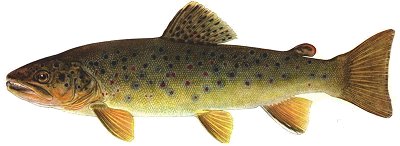
Salmo trutta
Size
to 41"
Although not native to North America, the widely-introduced European Brown Trout is the most common trout in our area. It thrives in poorer water conditions than native species. Salmon are very similar to trout but generally larger. Introduced from Europe to much of the United States during the late 1800s, the brown trout has adapted well, tolerating warmer water than the native brookie. Sides have a light brown or yellow cast with black spots and usually some orange or red spots. The spots often have whitish to bluish halos. The tail generally lacks spots but may have a few.
Brown trout were originally introduced from Germany and Scotland, and subspecies designations were given to stocks from each country. But because of widespread stocking and genetic mixing, these subspecies are no longer recognized. Sea-run browns are not considered a subspecies. Brown trout hybridize with brook trout to produce the tiger trout.
Browns can live in warmer, more turbid water than other trout. They prefer water from 60 to 65°F, but can survive at 75°F and will tolerate 80°F for short periods of time. They thrive in cool-water streams and lakes, but cannot reproduce in lakes.
Primarily fish eaters, brown trout also consume crayfish and terrestrial and aquatic insects. Large browns prey on smaller trout and other gamefish.
Spawn in fall, usually at water temperatures of 44 to 48°F. They move into shallow, gravelly areas of their home stream or into gravelly tributaries. Females dig a redd, and after spawning, cover it with gravel and abandon it.
Brown trout grow rapidly but are not particularly long-lived. Few survive beyond age 8. Lake-dwelling browns grow much faster than stream browns; males faster than females.
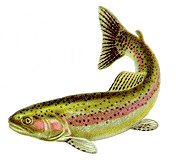
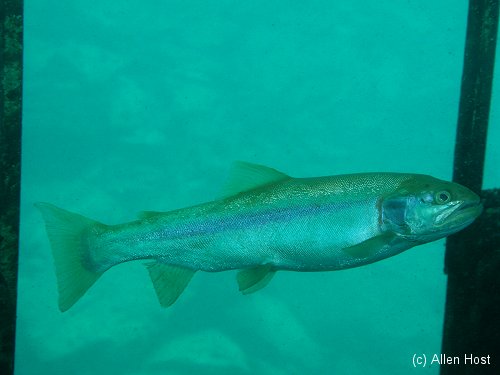
Rainbow trout are native to the area, although reduced in numbers due to human pressures and competition from the imported species. Like salmon, some Rainbow trout run out to sea for several years and then return to breed. Known as "Steelheads", these grow much larger than landlocked individuals and acquire a distinctly different blue-gray coloration.
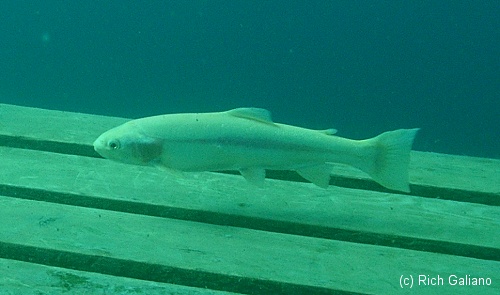
Dutch Springs has a large population of a yellowish sort of trout that is likely some kind of stock, commercially bred albino. Unlike the basses and sunfishes there, the trout do not like divers, and it is seldom that you will get very close to one, although you can often see them from the shore. Late in the season when cold water makes them sluggish and their food supplies collapse, the emaciated trout are easier to approach.
Freshwater gamefish such as trout and bass may not be taken by spear by divers. However, in some places, it may be legal to spearfish for carp, catfish, suckers, and other "rough" fishes - check local regulations.
More: Midwater Fishes ...