
Cusk & Striped Cusk Eel
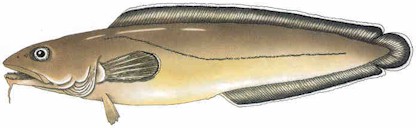
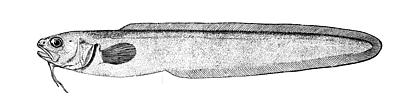
These fishes take the fin-merging of the Hakes one step further, merging all the unpaired fins and the tail into a single continuous margin. You can find tiny inch-long baby Cusk Brosme brosme under rocks and debris. Adults are found in coastal waters, in depths 60 ft and below, and grow to 39" and 27 lbs.
Striped Cusk Eel Ophidion marginatum ( not a true eel ) grows to 10". It will often back tail-first into the sand when frightened. Fawn Cusk Eel is similar but spotted. Cusk Eels are found in coastal waters and inlets, from shore to 180 ft.

Wildlife in New Jersey
The Striped Cusk-eel
Even if you're an avid angler or diver, chances are you've never seen a striped cusk-eel, despite the fact these fish play a key role in the ecosystem and are extremely abundant in New Jersey's bays, estuaries, and ocean zones near the shore.
In fact, striped cusk-eels (Ophidion marginatum), which are not true eels at all, can be found in waters from New York to northeast Florida. They can be found, that is, but only in the dark.
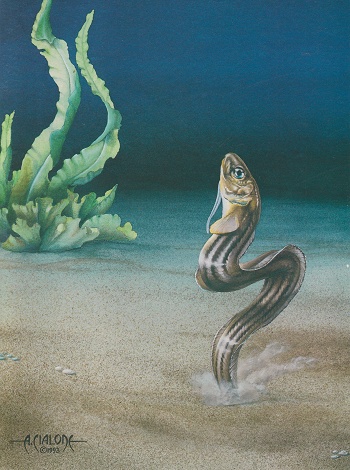
Cusk-eels are essentially nocturnal, spending most of the night hours searching for food with extended barbels, or feelers. Their diet consists primarily of grass shrimp and other small invertebrates. Around sunrise, most probably to avoid predators, these sleek creatures burrow tail-first into the sand. The burrowing motion is snake-like and graceful, with strong tail undulations propelling the fish vertically into the sandy substrate. During the day, all evidence of the cusk-eel vanishes except for a slight depression in the sand or a tell-tale snout extending ever so slightly into the water.
Although you may not have seen a cusk-eel, you may have heard one. These fish produce loud clicking sounds, which can sometimes be heard above shallow water and resemble the sound of a spinning roulette wheel. Sound is produced mainly by males of the species and is thought to be related to spawning behavior. The sound-producing organs in male cusk-eels are contained in a prominent head bump or "nuchal" crest that develops when the fish reach maturity. Females lack nuchal crests, since their sound-producing organs are located toward their tails. Scientists do not know at this point whether female cusk-eels actually produce sounds.
The spawning season for striped cusk-eels extends from mid-June through early September. Around sunset, male cusk-eels will begin to emit clicking sounds, or croaks, presumably to attract females. Once a female is enticed from her burrow, she will engage in courtship behavior with the male, allowing him to swim directly above her. After several minutes, the two fish rise in unison to the water's surface, with the female releasing a buoyant, gelatinous egg mass which is externally fertilized by the male. Egg masses are about one inch in diameter by two and one-half inches in length (depending on the size of the female), and contain hundreds to thousands of striped cusk-eel eggs. One female striped cusk-eel observed in a laboratory produced a large egg mass every night for 60 consecutive nights. A male observed under similar conditions engaged in spawning behavior with three different females, fertilizing three egg masses in five minutes. Interestingly, male cusk-eels stop producing sounds immediately after spawning occurs.
Striped cusk-eels, which grow to about 10 to 12 inches long, may play an important role in redistributing bottom sediments as a result of their burrowing activities. They also are thought to be an important food source for many fish of the Middle Atlantic region, including striped bass and summer flounder. However, one study demonstrated that, when swallowed whole by a striped bass, the cusk-eel can use its burrowing skills and kill its predator by digging through its stomach lining into its body cavity. ( In these instances, the cusk-eel also dies. )
So, the next time you are down the shore on a summer night, standing near the water's edge, don't look - but listen. If you happen to hear a strange clicking sound, you might very well be hearing the call of the striped cusk-eel.
by Jeanette Bowers-Altman, an assistant zoologist with the Division of Fish, Game and Wildlife's Endangered and Non-game Species Program
This article first appeared in New Jersey Outdoors - Fall 1993
Cods - family Gadidae - are one of the most commercially important families of fish in the sea. As such, they have been fished to the brink of disaster. The book above is a fascinating study of the historical relationship between western civilization and the codfish.
The only freshwater representative of the cod family is the Burbot.
More: Cods & Allies ...