Insects
Insects are almost completely lacking in the marine environment. I recall something about saltwater having a very bad effect on their lungless respiratory system ( although this does not affect spiders. ) Insects are quite common in freshwater environments though, both as larvae and adults. A little digging can turn up myriad types, but be careful, some of them can bite very painfully.
These are all known as "true bugs", as opposed to beetles, flies, ants, etc. Both the larval and adult stages are aquatic, although only the adult stages are shown here. All may be found swimming or clinging to underwater plants and must surface to breathe. All are also strong fliers that are attracted to lights at night and have a painful and poisonous bite. Giant Water Bugs are known to feed on small fishes.
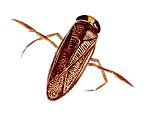
Water Boatman
Arctocorixia interrupta
to 1"
extremely common
More: Water Bugs ...
Beetles are differentiated from bugs by having the first pair of wings developed into armored shields, which protect the second pair of wings and the soft body. They can still fly with their second pair of wings, which fold up out of sight when not in use. Only adults are shown here.
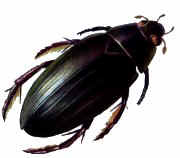
Water Scavenger Beetle
Hydrophilus triangularis
to 1.3"
Adults feed mainly on plant matter; larvae are carnivorous. Other diving beetles are predatory.
More: Water Beetles ...
Many insects which are terrestrial as adults have aquatic larvae. Notorious among these are mosquitos. Most aquatic insects have aquatic larvae.
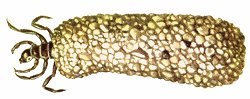
Caddisfly Nymph
Trichoptera
Caddisfly larva build tube-like cases of sand, sticks, leaves, or other material.
More: Aquatic Larvae ...
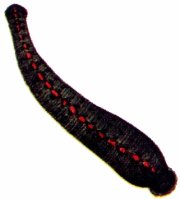
Macrobdella spp.
Size: to 10"
Habitat: aquatic
Notes: It's not a nice thought, but there are leeches in our freshwaters, and in marine habitats as well. The species shown is one of the largest and most attractive, if you can say such a thing. It feeds exclusively on vertebrate blood - a good reason to wear a wetsuit, although I've never encountered one. Leeches are actually worms, not insects, but ...
More: Leeches ...