
Eastern Pickerel
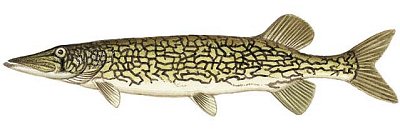
Esox niger
Size
to 39"
Eastern or 'Chain' pickerels are deep olive-green on the back, shading to a creamy yellow on the belly. Olive green blotches are present within distinct black chain-like or interwoven markings on the sides. There is a distinct dark, vertical bar below the eye. The cheek and gill covers are completely covered by scales. The underside of the lower jaw has 14-17 branchiostegal rays. There are no recognized subspecies. However, they hybridize readily with redfin pickerels. They are distantly related to trout and salmon.
Chain Pickerels are normally found in vegetated lakes, swamps and backwaters, and small to large rivers. They prefer water temperatures from 75 to 80°F.
Chain pickerels are random spawners rather than nest builders. Spawning occurs in late winter to spring among heavy aquatic weed growth or flooded grasses, in water from a few inches deep to several feet deep. A large number of adhesive eggs are scattered over vegetation. No nest is constructed and no parental care is given to the eggs or fry. About three to four weeks after hatching, they begin cannibalizing other fry.
Pickerels are lie-in-wait predators: they hide in the weeds and lunge out at small passing fishes. The chain pickerel's diet is mainly fish. They also eat insects, frogs, mice, crayfish, and a wide variety of other foods.
Sexes are similar. Sexual maturity is reached in the first to fourth year, and the maximum life span is probably eight to nine years. Females grow faster than males. In Florida, chain pickerels can reach lengths of up to 30 inches long.
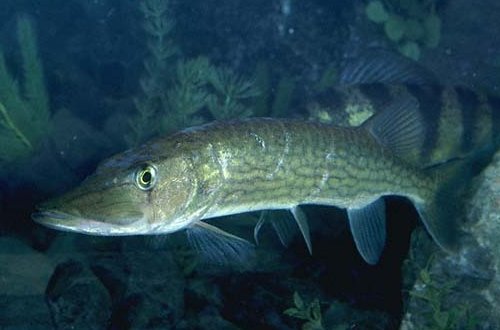
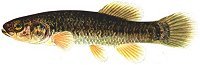
It's hard to believe that the little Mudminnow ( 4" ) is cousin to the Pickerel, but it is. Look at the layout of the fins. At the other end of the spectrum, the Muskellunge grows to six feet or more.
Freshwater gamefish such as trout and bass may not be taken by spear by divers. However, in some places, it may be legal to spearfish for carp, catfish, suckers, and other "rough" fishes - check local regulations.
More: Midwater Fishes ...