
Herrings

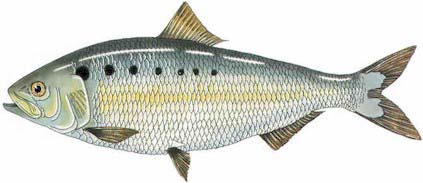
American Shad

American Shad
( right )
Alosa sapidissima

Size: to 30" and over 9 pounds

Habitat: coastal and estuarine waters

Notes:
Founding Fish

Oceanic adult herrings spend their days deep and come up to the shallows at night to feed, so you are not very likely to see them. Small ones may be more commonly found in inshore waters. Sometimes the marinas and inlets are full of tiny immature herrings known as "Peanuts." Saltwater herrings ascend rivers to spawn. All herrings are primarily filter-feeders, although larger ones may also be predatory on small fishes, squids, and other prey.

Shad is the largest member of the herring family. They are highly sought-after as sport fish when they make their annual upriver spawning migration in the spring. Some landlocked shads may spend their entire lives in freshwater. Menhaden is another of the many local species of herring.

All herrings and their small cousins sardines share the same saw-tooth scales on the belly, giving them the name "saw-bellies". That's why the Knights of Ni demanded that King Arthur "cut down the tallest tree in the forest with ... a herring!" -- from Monty Python and the Holy Grail
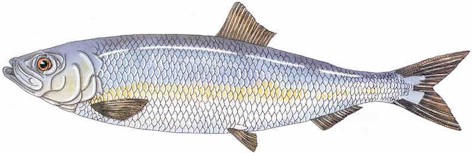
Atlantic Herring
Atlantic Herring - Alosa aestivalis - to 15"
Blue Shark feeding on herring (NEFSC)

The "Regulator Tax" and the Buddy System

You should probably just skip this section

The scuba industry has successfully convinced the diving public that annual servicing of regulators is essential for your safety. Actually, at $50-$100 per regulator per year, annual servicing of regulators is far more essential to their bottom line than it is to your safety. Am I so cheap that I would risk my life to save less than $100? Not really.

All this is mixed up in business, economics, liability, and the fallacious buddy system. As you know, in the buddy system your buddy is theoretically your backup emergency air supply underwater, insuring not only against out-of-air situations, but also against equipment failures, and therefore you need only one tank and regulator. In keeping with this theory, you are sold a wholly inadequate breathing system with no built-in redundancy at all. Then, to try to reduce the inherent danger of diving with such a system, or perhaps just the legal liability in promoting it, you are then "required" to have it "serviced" at least once a year, whether it needs it or not. In fact, this is the icing on the cake for the industry, since such servicing is far more profitable than sales! The real purpose of all this is to lower the entry cost of diving by several hundred dollars, expand the customer base as rapidly as possible, and maximize revenues, and all this is done at the expense of true safety. In an industry that professes to be obsessed with safety at all costs, this hypocrisy is almost beyond belief. ( I'm not saying your local dive shop is evil, but he'll go right along with the industry-standard because everyone else does, and he needs to make a living. )