Lobstering - Know Your Foe
Lobsters, like most invertebrates, have a much slower nervous system than our own. In tiny creatures, such as insects, this is no great disadvantage, since their "wire runs" ( or nerves ) are so short. However, in bigger invertebrates, this translates into very long reaction times. Therefore, big lobsters have slow reflexes, much slower than even humans. Another common invertebrate trait is a lack of stamina, at least compared to us. In other words, they tire quickly in a chase. This is not to say that they lack tenacity - once they get a good grip on you, they can hold on forever, and even breaking the claw off may not cause it to release.
Lobsters live in perpetual fear, even big ones, and their first instinct is to retreat from any threat. Their eyesight is poor, and their hearing does not seem to be very good either, although they are sensitive to vibrations. For this reason, swim up to them rather than crawl, and try to use a light only when absolutely necessary. The slightest touch to the sensitive antennae will cause the critter to back quickly into its hole with a flick of its tail. Shining a bright light in their eyes will have the same effect, so be careful where you point your dive light, and try not to use it if you can.
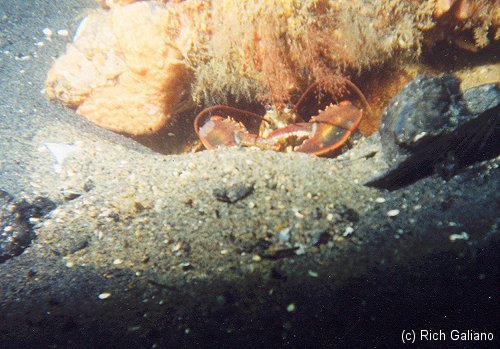
Lobsters like holes and dark places. During the day you will seldom find one out in the open. They are master excavators, and sometimes dig deep tunnels under structure. These holes are often easy to find since there will be a mound or fan of excavated sediment around the opening that is a different color than the rest of the bottom. They will also hide inside any confined place - a crevice, a bucket, a hollow wall. At night, after several hours of darkness, they come out to feed. At this time they are so easy to catch that most states forbid divers from lobstering at night.
Lobstering tails off in October-November through spring. The bigger males wander out to deep water, leaving behind many small males and egg-bearing females, none of which are legal catches. Perhaps one-in-five lobsters you catch at this time will be keepers. At this stage, the females are especially prone to shuck-off claws in self-defense, so it is important to be gentle when catching them, to avoid doing unnecessary harm. Also, once you have caught a short or pregnant lobster, do not put it back in its hole. This will only result in it being molested all over again by the next diver in your group; I have seen some poor females get groped until they have no claws left. Instead, release it in the sand and chase it away - it will find its way home eventually, after all the divers are gone.
This is what it's all about. Well, for some folks anyway. Yet, I have seen many beginners totally frustrated in their attempts to catch their first 'bug'. Perhaps these pointers will help:
Lobsters haven't evolved much in the last twenty years, but lobstering sure has. For one thing, bugs are a lot fewer and a lot smaller, unless you go way out deep. For another, the regulators took away our trophies with a maximum size limit, and they've also added seasonal closures. Not that I won't grab a nice bug if I can, but lobsters are not the same game they used to be, and not my motivation in diving.
More: Lobstering ...
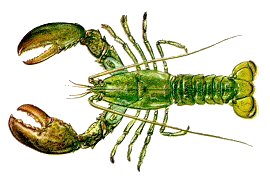
Homarus americanus
Size: to 36" and 45 lbs. (record)
Habitat: subtidal to the edge of the continental shelf, in any sheltered spot
Notes:
Lobsters differ from shrimps in having three pairs of clawed legs, the first with very large claws. Southern "Spiny Lobsters" are only distantly related; freshwater crayfish are closer. Lobsters, or "Bugs", are mainly nocturnal, and feed primarily on living or freshly killed food rather than scavenging on carrion, as was once thought. Although they are predominantly solitary creatures, lobsters do have a sort of social life amongst themselves. Males are more aggressive than females and will form pecking orders among individuals in an area. Female lobsters apparently seek the protection of a male when molting, then mate afterward. Lobsters shed their shells once or twice a year, depending mainly on the temperature.
More: American Lobster ...