
Squids & Octopus
Squids and octopuses are cephalopods ( Latin: "head-foots". ) They are extremely evolved mollusks. The shell is internalized as a support structure in squids, or completely absent, as in octopi. There are probably more squids than fish in the sea, both by numbers and by mass.
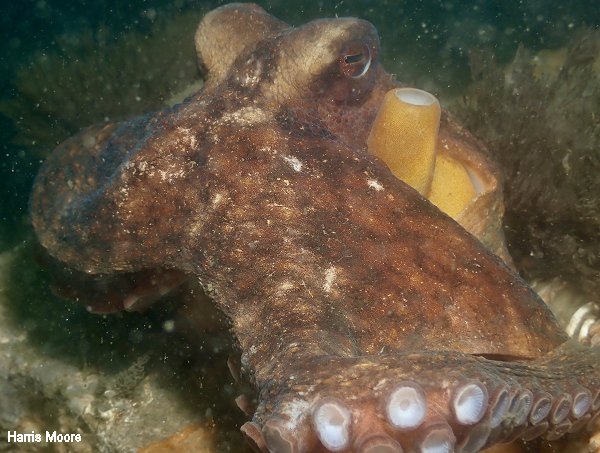
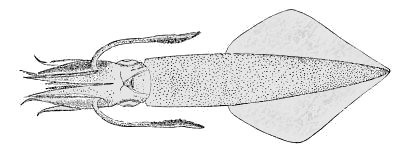
Loligo pealei
Size: to 17"
Habitat: Generally deep waters, but moves inshore in the summer. I have seen small ones at depths of 50-70 ft and babies in the rivers.
Notes:
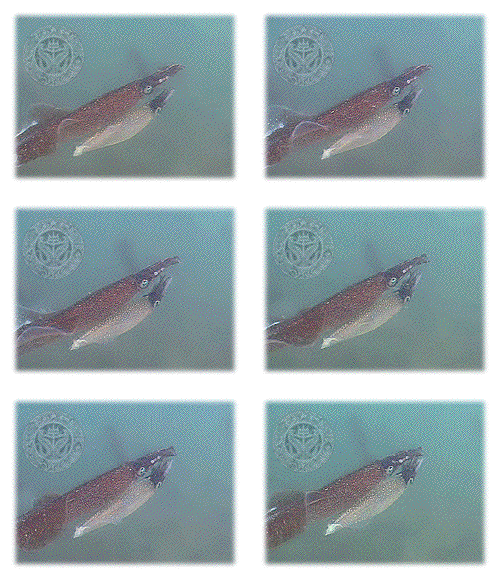
The squid is a mollusk, related to snails and clams. These animals travel in schools, swimming backwards by jet propulsion. Small specimens are nearly transparent except for the eyes. Tropical squids can show considerable intelligence and curiosity, but northern versions are, well, just stupid. I have seen huge schools of small transparent squids offshore, just their eyes visible, like black marbles. In the rivers, I have seen small schools of purple squids, and tiny colorless babies drifting in the current. All are predatory.
More: Squids ...
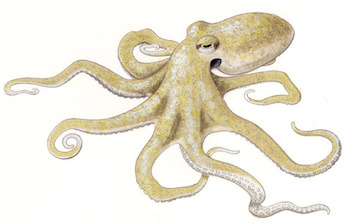
Octopus vulgaris
Size: see below
Habitat: rocks and coral reefs, all depths
Notes:
The Common Octopus is the most studied of all octopus species. Its natural range extends from the Mediterranean Sea and the southern coast of England to at least Senegal in Africa, as well as the Azores, Canary Islands, and Cape Verde Islands. In the western Atlantic, it ranges from Texas and Florida to New England, although uncommon in colder northern waters. Typical habitat is rocks and coral reefs. Young are planktonic, and total lifespan is only 12-18 months.
O. vulgaris grows to 25 cm in mantle length with arms up to 1 m long. They can weigh up to 20 pounds, although they are usually much smaller. O. vulgaris is caught by bottom trawls on a huge scale off the northwestern coast of Africa. More than 20,000 tons are harvested annually.
More: Octopus ...