
Echinoderms
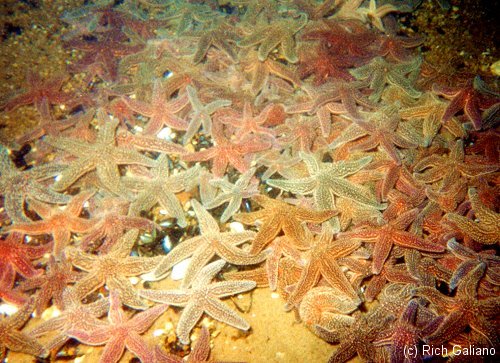
Echinoderms ( literally "spiny skins" ) are among the strangest animals on the planet. They start out as bilaterally symmetric larvae but grow into a 5-way body symmetry as adults. Some species show six, seven, or even higher levels of symmetry. Worm-like Sea Cucumbers have re-evolved a bilateral body plan over the underlying 5-way plan. Because of certain developmental traits, it is felt that despite their strangeness, echinoderms are actually more closely related to chordates than any other group.
All echinoderms have a water-hydraulic system that controls hundreds of tube feet with which the animal moves and feeds. They are also capable of stiffening their skins at will by creating new calcium bonds, which are later dissolved when no longer needed. This is how sea urchins lock their spines out when disturbed.
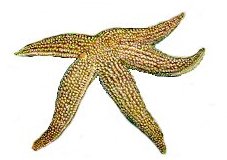
Starfish or Sea Stars are found on any solid structure, from inter-tidal rocks to deep wrecks. They are so common that one forgets just how bizarre they really are. These animals have 5-way body symmetry *, hydraulic tube feet, and ejects their stomach through their mouth to feed. ( Oddly, the planktonic larvae have bilateral symmetry, like higher animals. ) The "eye" is called a madreporite, and is actually the exhaust vent for the hydraulic system. They are capable of regenerating an entire animal from just a fragment. Starfish come in a rainbow of colors from yellow to lavender.
More: Starfish (Sea Star) ...
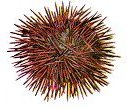
Arbacia punctulata
Size: to 3"
Sea Urchins may be found on any solid structure, from tidal rocks to deep wrecks, although in our region they are more common in shallow estuarine waters than offshore.
This animal is related to the starfish, and shares many of its traits, with one exception. Starfish are predators, feeding upon clams and mussels, while these sea urchins are strict vegetarians. I once ordered Sea Urchin at a sushi bar, but I never even tasted it, it smelled so bad. Nonetheless, it is a delicacy in much of the far east. Unlike tropical black urchins, our northern ones are not poisonous, and the spines are not even particularly sharp.
More: Purple Sea Urchin ...

Echinarachnius parma
Size: to 3"
Think of the Sand Dollar as a flattened Sea Urchin. They live on and slightly buried in sandy bottoms, at any depth.
Soak them in a bleach mixture and then rub off the spines with a rag to get a nice white keepsake. The tiny spines are like cactus needles and can be very irritating. Live Sand Dollars are pink; they turn green in death, and the indelible green pigment will rub off on anything it touches.
More: Sand Dollar ...
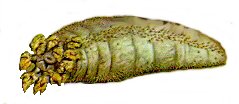
Sclerodactyla briareus
Size: to 6", larger offshore
The Sea Cucumber is not a worm, but an echinoderm, related to the starfish. If you look closely, the 5-way symmetry is still evident. Sea Cucumbers live buried in sandy or muddy bottoms less than 60 ft deep. Find them by the volcano-shaped mounds they make.
More: Hairy Sea Cucumber ...