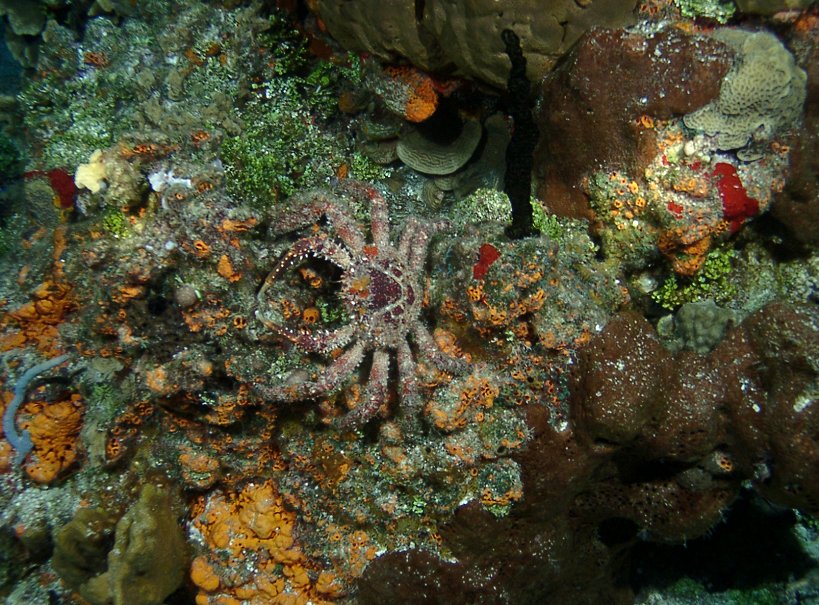
Now we're on the first night dive. A "Giant Crab" Mithrax (?) related to northern Spider Crabs.Mr Crab again.Yellow Stingray Urolophus jamaicensisA sleeping Stoplight Parrotfish Sparisoma virideSlipper Lobster Scyllarides nodifer or Sculptured Slipper Lobster Parribacus antarcticus
No claws, no spines, no teeth, no camouflage.
No fangs, no barbs, no bristles, no poison.
No strength, no speed, no brains.
You really have to wonder how they survive.
Common Atlantic Octopus Octopus vulgarisObviously not pleased to see me.I found this one on my own and didn't share it with anyone, which is probably why I was able to get some decent pictures.
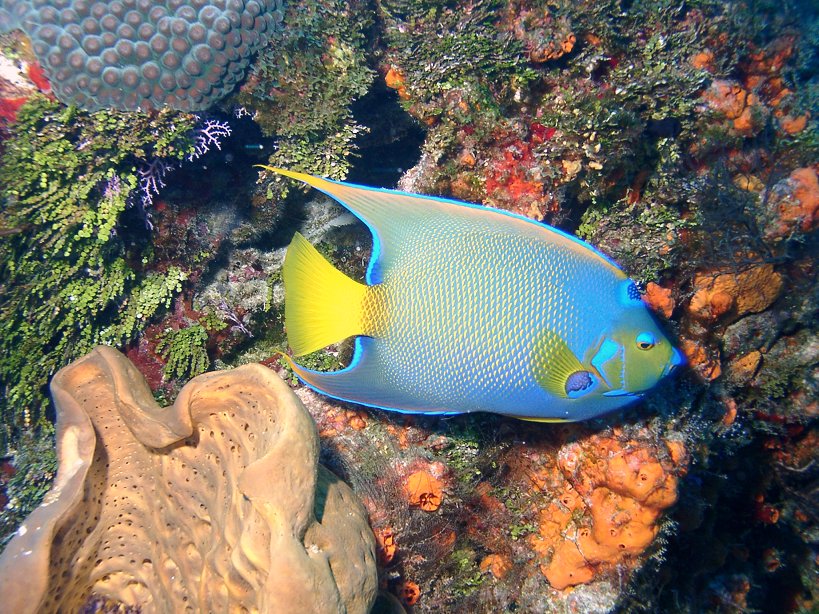
Punta Sur. Going into the hole.Coming out of the hole. I still don't understand why people dive in holes.Mostly French Grunts Haemulon flavolineatumAnother crab, oddly out in the open during the day.French Angelfish. I think these are the most majestic of the Angelfishes. Not as gaudy as the Queens, and a lot bigger.Stoplight Parrotfish ( female ). Males are bluish, like Queen ParrotfishQueen Triggerfish Balistes vetula. Headin' for the hills - I'm surprised I got this close. ( Photo is cropped - you can guess the range from the colors. )Blue Tang Acanthurus coeruleus and Squirrelfish Holocentrus adscensionisAlmost (Queen Angelfish)
Nighttime again. Sharptail Eel Myrichthys acuminatusAnother sleeping Stoplight Parrotfish, the terminal male phase. The bright yellow dot at the upper end of the gill slit is a giveaway.This little Yellow Stingray was happily digging a hole after something in the sand, and didn't mind having his picture taken at all.
Here is an assortment of large sharks that can be found in New Jersey waters, by no means all of them. These are more likely to be found offshore in oceanic waters. Sharks are seldom a danger to divers, they seem to be put off by the noise and bubbles. Nonetheless, all should be treated with caution.
Realistically, sharks in our waters are not a great concern. In over 350 northeast ocean dives, I have seen sharks on only several occasions ( not counting harmless little Dogfishes ) and only once while in the water. That one was in the Mud Hole, on the Arundo, to be precise. It was a Blue, or possibly a Mako, and wanted nothing to do with me, which was a relief since I had half an hour of deco left to do at the time! That would have left me very bent otherwise.
Note the difference between the toothless Basking Shark at left and the very not toothless Great White Shark at right.
If you think about it, humans must taste terrible to sharks, and scuba divers especially - with rubber suits and big metal tanks. Many shark attacks occur in murky water where the shark is not sure what it is attacking. Some attacks have been the result of the shark being stepped on in shallow water. Most shark attacks on humans are abortive, the shark taking only one exploratory bite, then realizing its mistake and breaking off the attack. Unfortunately, with a large shark, one bite and you're dead. Many predators, from bears to tigers, will prey on humans when sickness, injury, or old age make them unable to catch their normal prey. Sharks are probably no different.