
Collecting Shellfish
Something almost anyone can catch is shellfish. They really don't put up much of a fight or try to escape, so even a beginning diver can take something home for the dinner table.
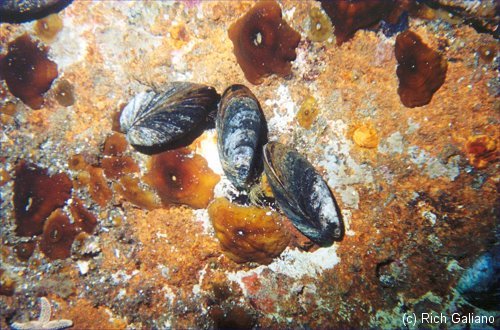
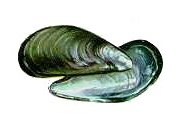
Mussels are easy. they grow almost everywhere - on any hard surface. They are the lawn grass of the sea. All you have to do is pluck them and put them in your bag. Don't waste a lot of time selecting them individually underwater. Just grab big clumps as fast as you can, and stuff them in your bag. Sort them out topside later, when your nitrogen clock isn't running. Take more than you think you'll want because you will end up discarding a lot of what you take this way.
More: Collecting Mussels ...
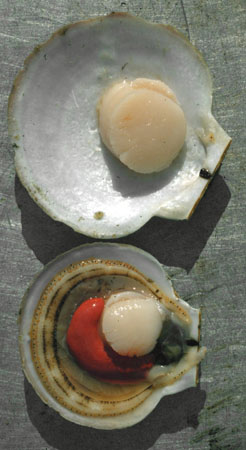
Scallops are not nearly so easy to get as Mussels but are well worth it. I have never seen a scallop in less than 90 ft of water, most often in 110 ft and below. Sadly, the commercial scallop boats have quite efficiently decimated the scallop population, and they are fairly rare, especially in any kind of useful quantity.
When you do get into a field of scallops though, life is good. Scallops live on the surface of the sand ( rarely on the deck of a wreck ) where each one will excavate a shallow pit. The pits are usually 2-3 ft apart, and a good field of scallops will stretch as far as you can see. Fortunately, good fields like this are usually in the vicinity of wrecks or snags, where the scallop boats will not go with their expensive bottom gear.
More: Collecting Scallops ...
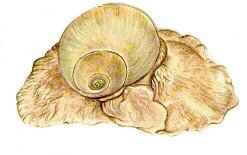
Moon Snails are commonly eaten as Scungilli. They are sometimes very common offshore; more than that I can't say.
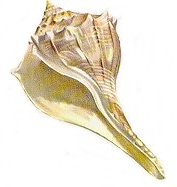
Large Whelks are sometimes eaten as Conch, but these are most often collected in bay waters.
More: Collecting Other Shellfish ...
When just floating around isn't enough ...
- Photography & Video ...
- Lobstering ...
- Spearfishing ...
- Collecting Shellfish ...
More: Diving Activities ...
Mussels are easy. they grow almost everywhere - on any hard surface. They are the lawn grass of the sea. All you have to do is pluck them and put them in your bag. Don't waste a lot of time selecting them individually underwater. Just grab big clumps as fast as you can, and stuff them in your bag. Sort them out topside later, when your nitrogen clock isn't running. Take more than you think you'll want because you will end up discarding a lot of what you take this way.
More: Collecting Mussels ...
Scallops are not nearly so easy to get as Mussels but are well worth it. I have never seen a scallop in less than 90 ft of water, most often in 110 ft and below. Sadly, the commercial scallop boats have quite efficiently decimated the scallop population, and they are fairly rare, especially in any kind of useful quantity.
When you do get into a field of scallops though, life is good. Scallops live on the surface of the sand ( rarely on the deck of a wreck ) where each one will excavate a shallow pit. The pits are usually 2-3 ft apart, and a good field of scallops will stretch as far as you can see. Fortunately, good fields like this are usually in the vicinity of wrecks or snags, where the scallop boats will not go with their expensive bottom gear.
More: Collecting Scallops ...