Hydromedusae
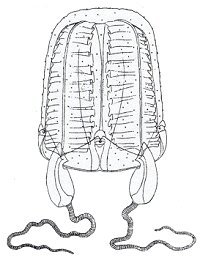
Although superficially similar to jellyfishes, hydromedusae are more closely related to sessile hydroids. They are much firmer and sturdier in body than jellyfishes. Most are small ( less than 1 inch in diameter ) and do not sting. Others, such as the large and very dangerous Sea Wasp ( 9", right ) do.
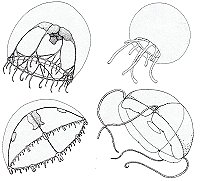
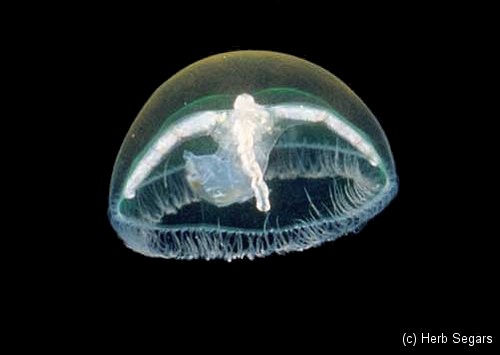
The White Cross Hydromedusa is found along the coast from the Arctic to Rhode Island. At night it rises to just below the surface. It feeds on other medusae and crustaceans. In the northern part of its range, it is seen from spring through late summer. In the southern range, it is normally found from spring to early summer. It can reach 12" wide and 2" high and is not dangerous to humans.
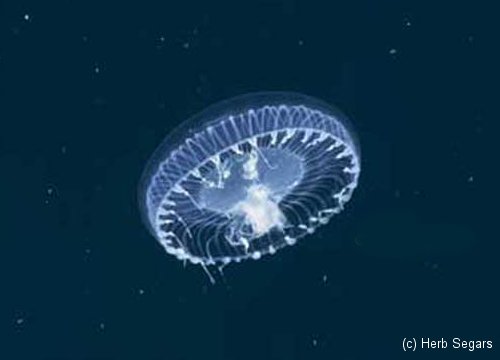
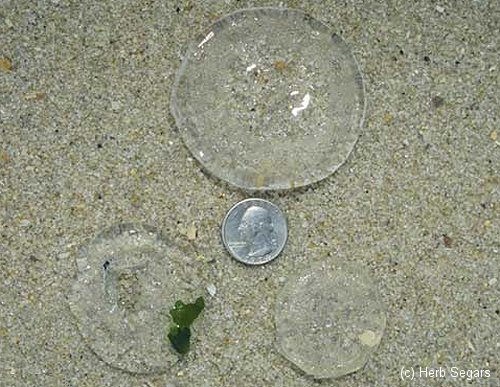
The "many-ribbed" genus of hydromedusae are similar in appearance to clear jellyfishes, but lack obvious tentacles and do not sting when touched. These are among the largest hydromedusae known, up to 12" across, and the identity of their corresponding polyp stage is still a mystery. Hydromedusae are mostly water, and when they dry up they lose half of their diameter and almost all of their thickness, becoming sand dollar-sized thin, brittle discs.
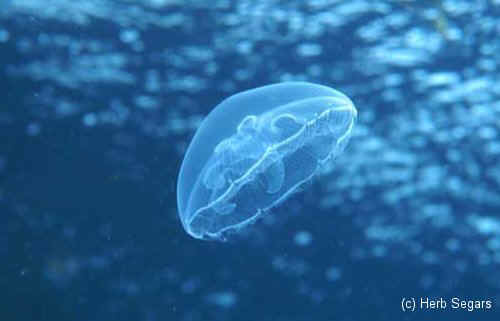
The many creatures on this page are lumped together for the one trait they all have in common - they are all "jelly-like" - soft, gelatinous, and more-or-less transparent. Other than that, they are for the most part completely unrelated. True Jellyfishes, Hydromedusae, and Siphonophores are in the phylum Cnidaria, related to bottom-dwelling Hydroids, Sea Anemones, and corals. Comb Jellies are in the phylum Ctenophora, and are completely unrelated to jellyfishes, as are Sea Butterflies and Corollas, which are mollusks. Salps are free-swimming tunicates, more closely related to us than to any of these other creatures.
More: Jellyfishes ...