Scallops
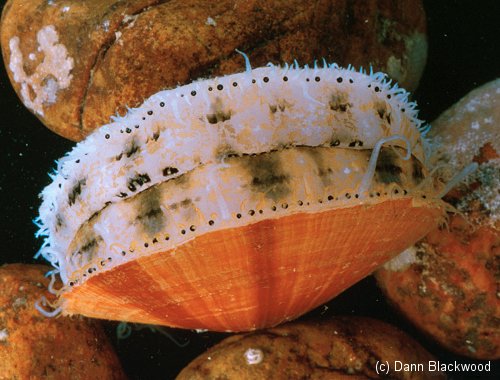
Scallops can swim in spurts by clapping their shells. Water is ejected backward through openings on either side of the hinge, propelling the scallop in the opposite direction - surprising to see for the first time. When not jetting around, they settle into evenly-spaced shallow pits in the sand.
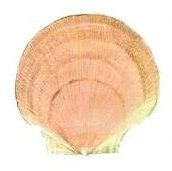
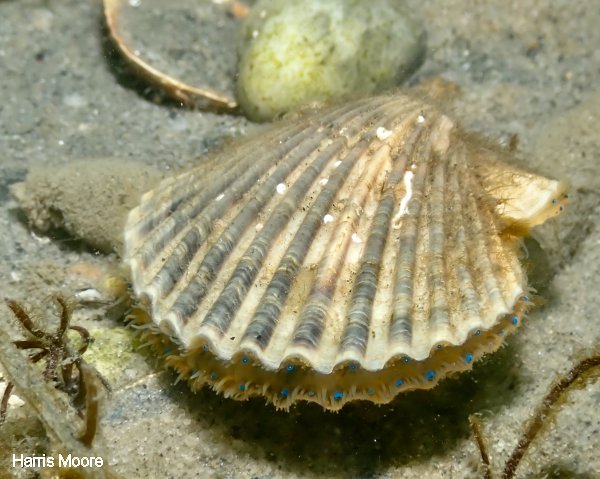
The Deep Sea Scallop Placopecten magellanicus (right) grows to 8" and is found offshore, generally in water over 100' deep. The smaller but equally edible Bay Scallop Aquipecten irradians, to 3", is found in bays and protected shallow waters. The Bay Scallop has a deeply ribbed shell, while the Deep Sea Scallop has many tiny ribs.

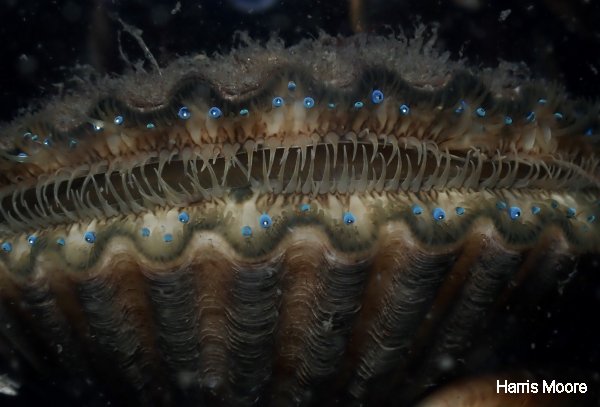
Scallops have many eyes around the edge of the shell and can see well enough to tell when a diver is coming after them. And they have reason to be worried as well - they taste great raw right out of the shell, and make a great snack on the boat between dives! The edible part is a plug of muscle that opens and closes the shell.

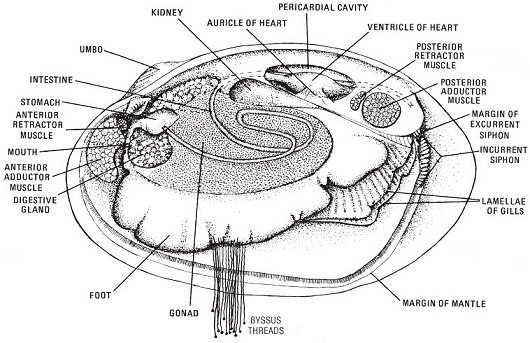
All of these bivalves are filter feeders. The other major group of mollusks is the Gastropods or snails. Squid and octopus ( cephalopods ) are mollusks too, but they don't behave like other mollusks, so I included them elsewhere. Teredos are bivalves that have evolved a worm-like wood-boring habit.
More: Bivalves ...
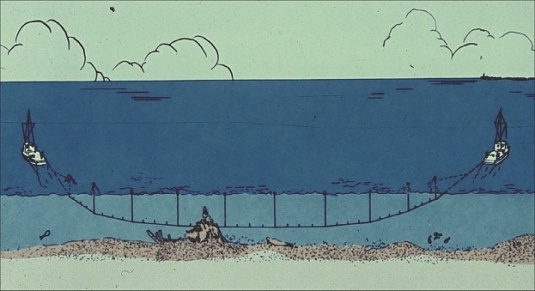
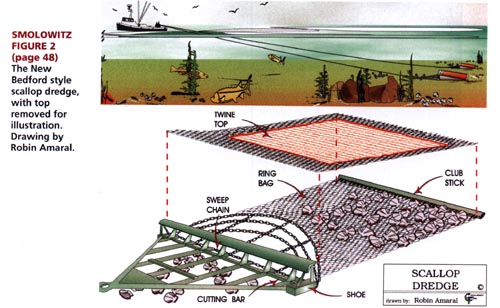
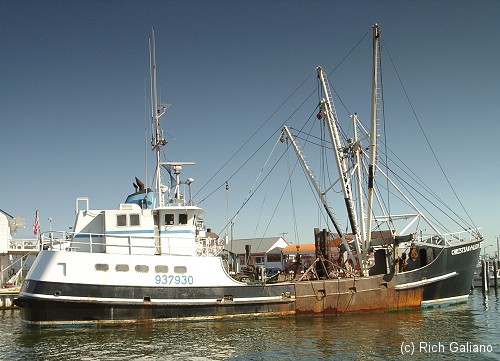
Scallop dredging is similar to clam dredging in that large metal rakes are dragged across the bottom. However, that is where the resemblance ends. Since scallops live on the surface, unlike buried clams, they can be harvested with much lighter-weight gear. A scallop rake is typically much smaller than a clam rake, consisting of a triangular frame with a chain-link catch-bag. No hydraulics are necessary. Such gear does not require as much towing power as for clamming. Since scallops are cleaned at sea as they are caught, and all the heavy shells discarded, there is also much less on-board storage requirement. Scallop boats can therefore be smaller than clam boats, and some are quite small indeed. In fact, the entire business model seems to be different, and it appears that a few small privately-owned operations persist to this day, in contrast to clamming, which is now dominated by a few corporate fleets.
More: Scallop Dredges ...
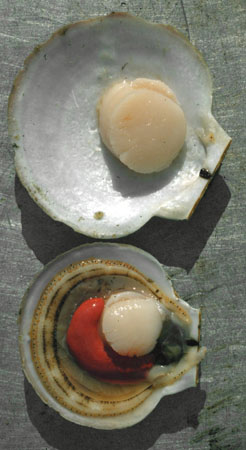
Scallops are not nearly so easy to get as Mussels but are well worth it. I have never seen a scallop in less than 90 ft of water, most often in 110 ft and below. Sadly, the commercial scallop boats have quite efficiently decimated the scallop population, and they are fairly rare, especially in any kind of useful quantity.
When you do get into a field of scallops though, life is good. Scallops live on the surface of the sand ( rarely on the deck of a wreck ) where each one will excavate a shallow pit. The pits are usually 2-3 ft apart, and a good field of scallops will stretch as far as you can see. Fortunately, good fields like this are usually in the vicinity of wrecks or snags, where the scallop boats will not go with their expensive bottom gear.
More: Collecting Scallops ...
Fish
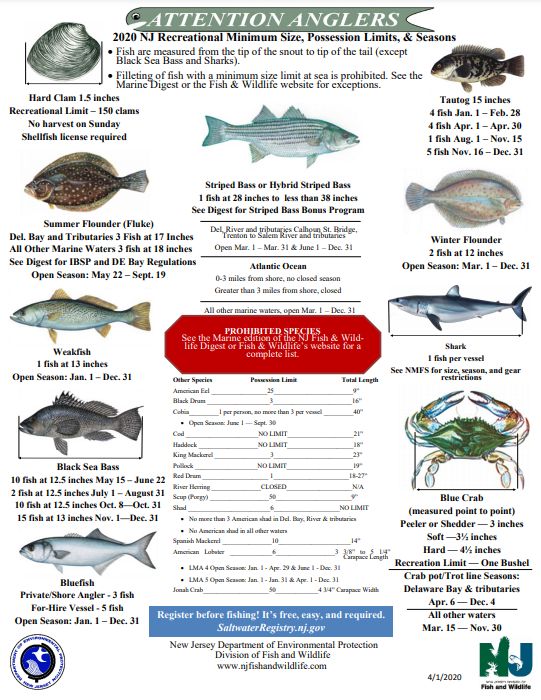
New Jersey now requires registration for saltwater fishing, including lobsters. Registration is free and can be done online at nj.gov/dep/saltwaterregistry.
This listing is for New Jersey waters only - if you cross into New York or Delaware, or Federal waters ( more than 3 miles offshore, ) you are subject to their regulations. Federal regulations supersede state regulations whenever stricter.
Lobster
More: Fishing Regulations ...