
Mussels
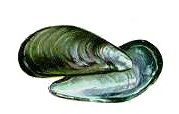
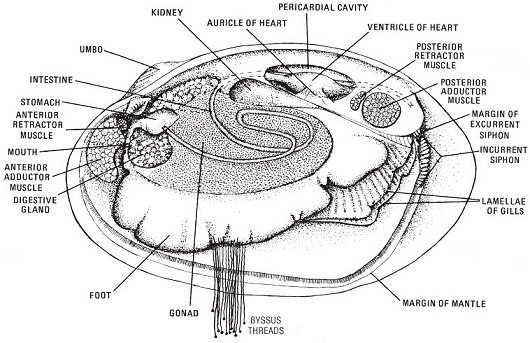
Mussels are found everywhere, attached to any solid substrate. Mussels are to the sea what grass is to suburbia. Mussels lack the muscular foot of clams or the large hinge muscle of scallops. Instead, they have a "beard" of tough fibers near the hinge with which they attach themselves.
The Blue Mussel Mytilus edulis, to 4" is the edible mussel. The similar Horse Mussel Modiolus modiolus grows to 6", and is considered inedible. Both types are found from the intertidal zone down to the depths. See entry on barnacles.
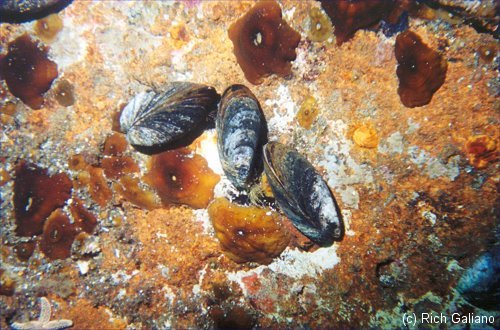
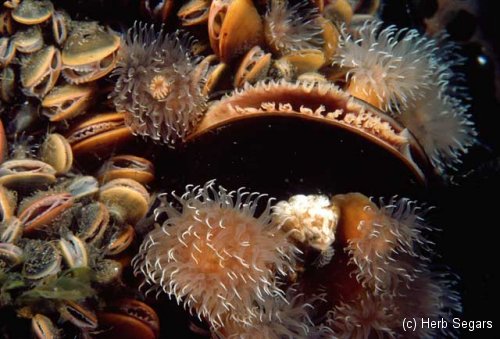
The other common type of mussel in our area is the Ribbed Mussel Modiolus demisus, to 4". The Ribbed Mussel is roughly the same shape as the Blue Mussel, but has a ribbed shell instead of smooth. It is usually found in brackish water, in bays, estuaries, and marinas, and is inedible. Freshwater Zebra Mussels are more closely related to clams.
All of these bivalves are filter feeders. The other major group of mollusks is the Gastropods or snails. Squid and octopus ( cephalopods ) are mollusks too, but they don't behave like other mollusks, so I included them elsewhere. Teredos are bivalves that have evolved a worm-like wood-boring habit.
More: Bivalves ...
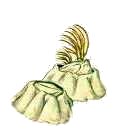
Barnacles are the strangest of crustaceans. Imagine a tiny shrimp glued down by the top of its head, with its antennae waving in the current, and you begin to understand what a barnacle really is.
Northern Rock Barnacles ( Balanus balanoides, to 1" ) grow in the intertidal zone, subtidal in places, attached to any hard surface. They are in constant competition for living space with mussels. Mussels grow faster but are more susceptible to drying out. Therefore, mussels quickly take over the lower wetter areas, while barnacles rule in the higher dryer reaches.
More: Barnacles ...
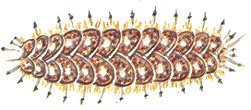
Lepidodontus spp.
Size: to 2"
12-scale worms are usually found while separating and cleaning mussels. They seem to be harmless and inoffensive. In the illustration, the head is at the left. There are many varieties, some with more or less scales.
More: 12-Scaled Worm ...
Mussels are easy. they grow almost everywhere - on any hard surface. They are the lawn grass of the sea. All you have to do is pluck them and put them in your bag. Don't waste a lot of time selecting them individually underwater. Just grab big clumps as fast as you can, and stuff them in your bag. Sort them out topside later, when your nitrogen clock isn't running. Take more than you think you'll want because you will end up discarding a lot of what you take this way.
More: Collecting Mussels ...
Fish
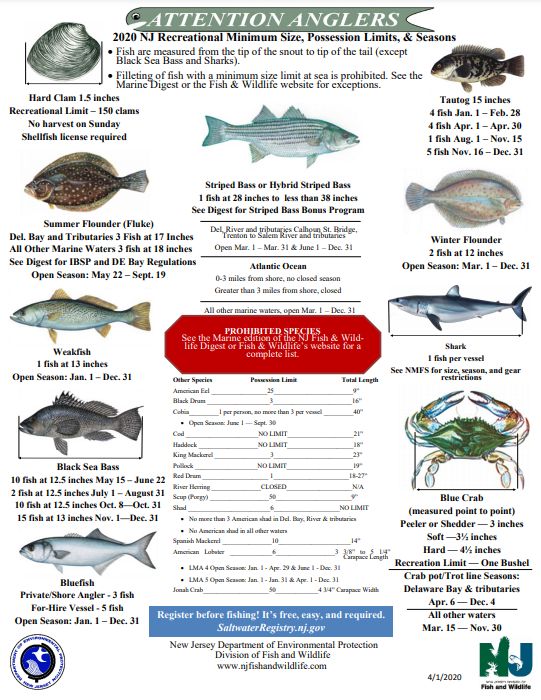
New Jersey now requires registration for saltwater fishing, including lobsters. Registration is free and can be done online at nj.gov/dep/saltwaterregistry.
This listing is for New Jersey waters only - if you cross into New York or Delaware, or Federal waters ( more than 3 miles offshore, ) you are subject to their regulations. Federal regulations supersede state regulations whenever stricter.
Lobster
More: Fishing Regulations ...