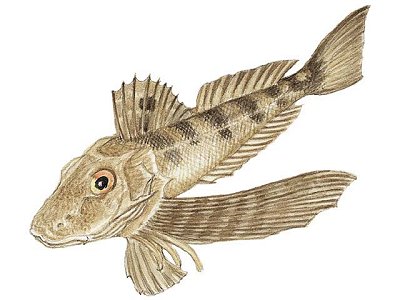
Northern Sea Robin

Northern Sea Robin

Prionotus carolinus

Size:
to 16"

Description:
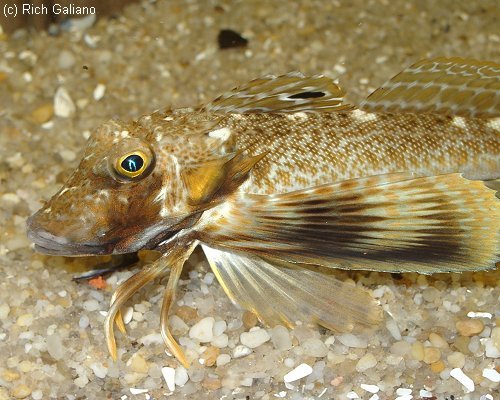
Sea Robins are distinguished by the three free rays of the pectoral fins, with which the fish can actually walk across the bottom. They make frog-like croaking sounds when disturbed. Sea Robins have razor-sharp gill covers and spines, and are best left alone - there's not much meat on them anyway.

Sea Robins are generally found inshore in harbors and inlets, in 30-40 foot depths, but move out to deep waters in winter.
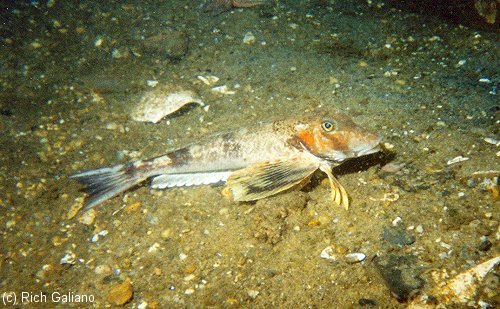
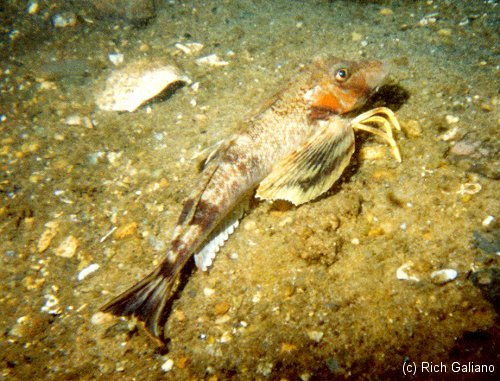
Northern Sea Robin

Northern Sea Robin
The Sea Robin uses its "legs" to walk across the bottom and even turn over small stones.
Northern Sea Robin
Northern Sea Robin
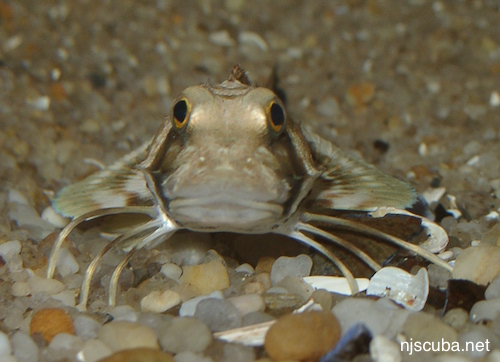
Nose to nose with a baby Robin in an aquarium.
Northern Sea Robin
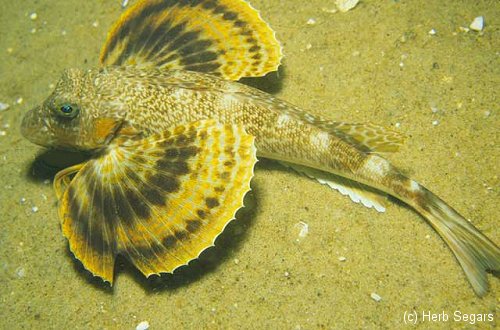
Divers can appreciate these extraordinary creatures, although fishermen revile them.
Herb Segars Photography


Marine Life Colonization of Experimental
Reef Habitat in Temperate Ocean Waters of New Jersey

By Bill Figley
January 2003

This investigation was partially funded by the Federal Aid to Sportfish Restoration Program

for the original paper, see here.


ABSTRACT

A biological colonization study of experimental reef habitats in temperate ocean waters off New Jersey was conducted over a 96-month period. A total of 145 different taxa of 9 phyla were identified within the experimental units, including 42 arthropoda, 37 annelida and 43 molluska. Individual organisms had an estimated mean abundance of 534,566 organisms/m2 of habitat footprint, including 105 fish, 4,639 crabs and 14 lobsters. Colonial organisms covered 87,554 cm2 of the habitat surface area. Mean total biomass of the organisms inhabiting the units was 84,175 g/m2, with blue mussel comprising 63 percent of the total. The carrying capacity of the experimental habitat for all species of marine life was about 152,801 g/m2. Predation accounted for an 80 percent reduction of biomass between surfaces exposed and not exposed to predators. There were no statistically significant differences in biological colonization rates of sessile epibenthos on concrete, rock, steel and rubber substrates. On an equivalent area basis, the biomass enhancement ratios of the experimental reef habitats over surf clam-dominated and polychaete/crustacean-dominated sand bottom habitats ranged from 35 to 1,124 and 2,773 to 3,200 times, respectively. A simplified, three-tiered reef habitat food chain consisted of 84.5 percent sessile/sedentary invertebrates, 11.0 percent mobile invertebrates and 4.5 percent juvenile and adult fish. The results suggest that complex reef habitats provide both attachment surfaces and refuge habitats that support a diverse and abundant marine life community.