Algae & Seaweeds
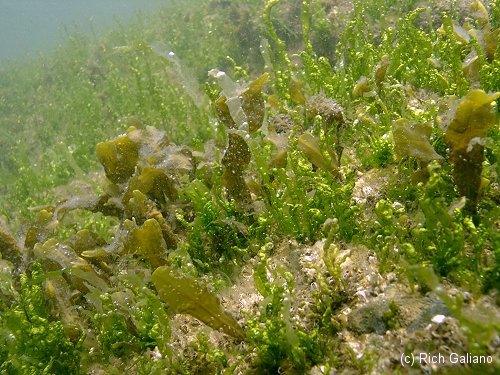
In our waters, plants and algae are found only in shallow water where sufficient light can penetrate for photosynthesis. It would be unusual to find algae below 10-20 ft, so our wrecks and reefs, despite the profusion of attached organisms, are actually devoid of plant life! Of course, that is completely neglecting the microscopic algal plankton that is so profuse in our waters and so lacking in the clear water of the tropics.
Algae lack the complex structures of true plants: roots, stems, and true leaves. Some algae have a holdfast that resembles a root, and they may superficially resemble higher plants, but their internal structure is completely different. Algae vary from the microscopic single-celled organisms that form the base of the marine food chain to the gigantic northern kelps. Unlike higher plants, not all algae have green chlorophyll; shades of red, purple, yellow, and brown are also found. All types of algae are represented in freshwater as well.
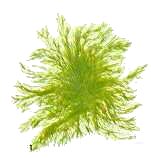 Cladophera 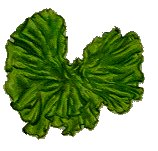 Ulva or Sea Lettuce | 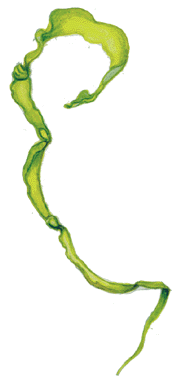 Enteromorpha or Hollow Green Weed |
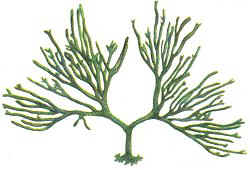
Green algae take many forms, some of which superficially resemble grass and other plants. Cladophora grows in tufts 3"-12" in size. Sea Lettuce - Ulva lactuca - is a green algae that grows in large sheets up to 36" like tissue paper. Small specimens are attached, but large ones are usually found drifting. It is edible and extremely common in protected waters. Enteromorpha algae superficially resembles eelgrass, and like eelgrass may also grow in thick beds.
More: Green Algae ...
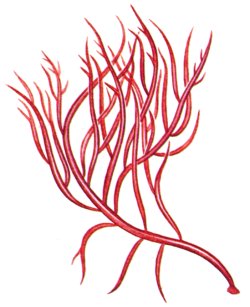
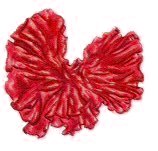
Red algae actually vary in color from straw-yellow to deep-purple or black in appearance.
Agardh's Red Weed - Agardhiella subulata is very common and grows in tufts and clumps to about 12" in sunny shallow areas.
Laver or Porphyra ( above ) is similar to Ulva in many ways, although unrelated. It grows interspersed with Ulva in shallow sunny areas, and like Ulva, it is edible.
More: Red & Purple Algae ...
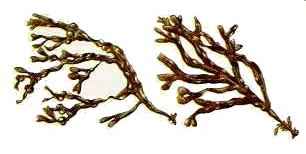
Pictured is a type commonly known as Rockweed ( Fucus vesiculosus, or Bladderwrack ) a tough northern type, adapted to the rocky shores of New England. However, it is more than happy to grow on jetties and pilings wherever it finds them and is quite common in the inlets around New Jersey. Like many other forms of algae, this one has gas bladders for flotation.
More: Yellow & Brown Algae ...
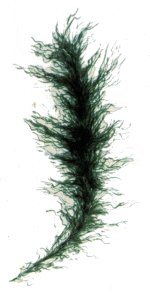
Most blue-green algae are inconspicuous, forming slimes or velvety coverings on any available surface. Some blue-green algae, not all of which are blue-green in color, are capable of surviving in extreme conditions that kill most other forms of life. Some give off toxins that are harmful or fatal to other forms.
More: Blue-Green Algae ...
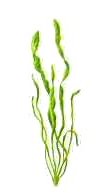
Zostera marina
Size: to 36"
Seagrass: Nature's Nursery
Seagrasses are a group of approximately 50 species of vascular plants that complete their entire life cycle fully submerged in the marine environment. The most common and ecologically important seagrasses in New Jersey are eelgrass ( Zostera marina ) and widgeon grass ( Ruppia maritima ). Widgeon grass, however, is actually a fresh/brackish water plant with extreme salinity tolerance and is therefore sometimes not classified as a "true" marine seagrass.
More: Eelgrass ...