
Susan Rose Update

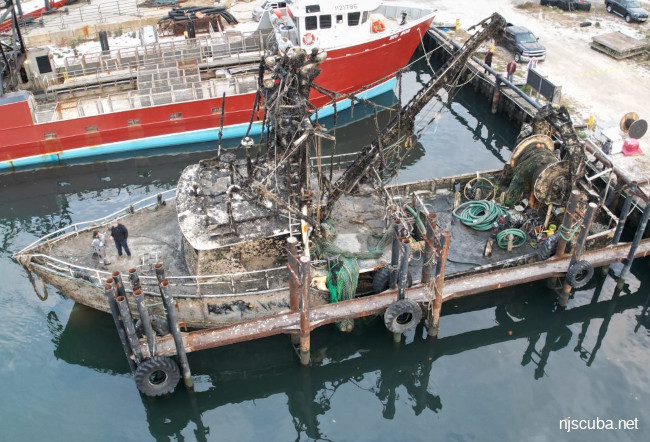
The Susan Rose has been raised and is presently at a dock in Point Pleasant. Hopefully it will be sunk on a New York reef, for all to use.

Dragger Susan Rose Raised One Year After Sinking

National Fisherman Staff
Mid-Atlantic Northeast News
November 22, 2024
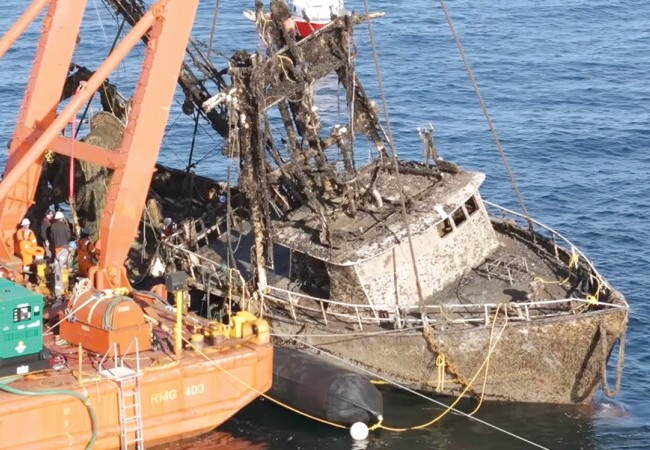
Resolve Marine's RMG 400 lift barge raised the trawler Susan Rose from where it sank off Point Pleasant Beach, N.J. in November 2023. Jersey Shore Fire Response Photo.

The Rhode Island steel trawler Susan Rose was raised from the sea floor this week a year after sinking off Point Pleasant Beach, N.J., removed as a hazard to navigation.

Resolve Marine’s RMG 400 lift barge brought the Susan Rose to the surface Nov. 19, a year and two days after the 77-foot dragger ran aground on the beach while heading in for Manasquan Inlet.

After the 2023 grounding, the fishing boat’s crew of four safely got off onto the beach, dropping down from the deck with help from Point Pleasant Beach emergency responders.

Efforts to defuel, lighter and salvage the boat began that day and the Dann Towing 85’x30’x11.5’ tugboat Shannon Dann got underway from Staten Island in anticipation of a high tide for the recovery effort. The initial salvage was commissioned by The Town Dock of Narragansett, R.I., owners of the Susan Rose.

That original plan last year was to move the boat off the beach after its fuel and oil tanks were safely emptied, then tow it to a Staten Island shipyard for repair. But during the move, the boat took on water and sank in 48 feet of water about 3,000 feet off the beach.

Built in 1977 by Steiner Shipyard in Bayou La Batre, Ala., the 77’x23’ 142 gwt Susan Rose was one of the Town Dock commercial fleet, homeported at Point Judith, R.I., and frequently working out at other Northeast ports depending on fishing seasons.

The week-long salvage work by Resolve and Northstar Marine also involved the Coast Guard and local partner agencies, including the New Jersey Department of Environmental Protection, state police Office of Emergency Management, Ocean County Sheriff’s Department Office of Emergency Management and the Point Pleasant Beach Police Department.

Before any next steps those authorities will assess the material condition of the Susan Rose, tied up at a dock on Channel Drive in Point Pleasant Beach. That fueled speculation in the port that the Susan Rose could be bound for the sea floor again, as an addition to an artificial reef.

- nationalfisherman.com

Marine Life Colonization of Experimental
Reef Habitat in Temperate Ocean Waters of New Jersey

By Bill Figley
January 2003

This investigation was partially funded by the Federal Aid to Sportfish Restoration Program

for the original paper, see here.


ABSTRACT

A biological colonization study of experimental reef habitats in temperate ocean waters off New Jersey was conducted over a 96-month period. A total of 145 different taxa of 9 phyla were identified within the experimental units, including 42 arthropoda, 37 annelida and 43 molluska. Individual organisms had an estimated mean abundance of 534,566 organisms/m2 of habitat footprint, including 105 fish, 4,639 crabs and 14 lobsters. Colonial organisms covered 87,554 cm2 of the habitat surface area. Mean total biomass of the organisms inhabiting the units was 84,175 g/m2, with blue mussel comprising 63 percent of the total. The carrying capacity of the experimental habitat for all species of marine life was about 152,801 g/m2. Predation accounted for an 80 percent reduction of biomass between surfaces exposed and not exposed to predators. There were no statistically significant differences in biological colonization rates of sessile epibenthos on concrete, rock, steel and rubber substrates. On an equivalent area basis, the biomass enhancement ratios of the experimental reef habitats over surf clam-dominated and polychaete/crustacean-dominated sand bottom habitats ranged from 35 to 1,124 and 2,773 to 3,200 times, respectively. A simplified, three-tiered reef habitat food chain consisted of 84.5 percent sessile/sedentary invertebrates, 11.0 percent mobile invertebrates and 4.5 percent juvenile and adult fish. The results suggest that complex reef habitats provide both attachment surfaces and refuge habitats that support a diverse and abundant marine life community.