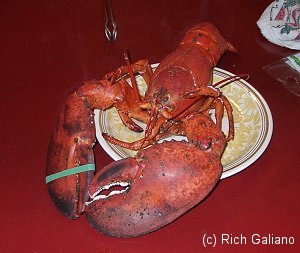
Collecting Scallops
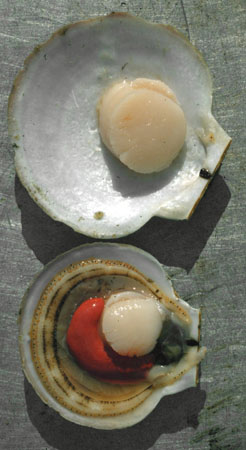
Scallops are not nearly so easy to get as Mussels but are well worth it. I have never seen a scallop in less than 90 ft of water, most often in 110 ft and below. Sadly, the commercial scallop boats have quite efficiently decimated the scallop population, and they are fairly rare, especially in any kind of useful quantity.
When you do get into a field of scallops though, life is good. Scallops live on the surface of the sand ( rarely on the deck of a wreck ) where each one will excavate a shallow pit. The pits are usually 2-3 ft apart, and a good field of scallops will stretch as far as you can see. Fortunately, good fields like this are usually in the vicinity of wrecks or snags, where the scallop boats will not go with their expensive bottom gear.
Once you've found the scallops, all you have to do is pick them up, as fast as you can. There is a minimum size to observe, but your biggest worry will be bottom time. At the depths that scallops are found, your nitrogen clock will be running fast, and it is easy to get greedy and stay too long. A big bag of scallops can be quite heavy and require a lot of air in your BC to lift, so make sure that you ascend the anchor line when returning to the boat. Barring that, shoot the scallops to the surface with a lift bag to avoid making an especially risky free ascent.
Once you are back in the boat, it is time to clean your catch. Sort out the undersized ones and toss them back. Get a long-bladed knife - a fillet knife will work; your dive knife will do in a pinch. You don't want anything very sharp that you might cut yourself with; purpose-made scallop knives are quite dull.
On either side of the shell's hinge is an opening where you can slide the knife in. Insert it along the hinge, and work it outwards along the flat lower shell, to cut the shell-closing muscle. Open the animal up, and look for the adductor muscle, the one you just cut. It will be a firm white round plug. Cut it out with your knife, or just pluck it out with your fingers. The muscle is the only edible part of the scallop - discard the rest. This is the depressing part of collecting scallops: a bag full of shells yields just a cup full of plugs. But are they good! You can even eat them raw if you are prone to such things. As with all seafood, get them on ice immediately. There are many scallop recipes that can be found with a quick search.
Note:
Since the 1980s, it has been illegal to take scallops from Federal waters ( beyond 3 miles ) without a Federal scallop permit.

Something almost anyone can catch is shellfish. They really don't put up much of a fight or try to escape, so even a beginning diver can take something home for the dinner table.
More: Collecting Shellfish ...
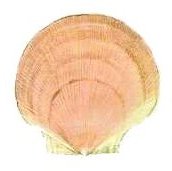
Scallops can swim in spurts by clapping their shells. Water is ejected backward through openings on either side of the hinge, propelling the scallop in the opposite direction - surprising to see for the first time. When not jetting around, they settle into evenly-spaced shallow pits in the sand.
The Deep Sea Scallop Placopecten magellanicus (right) grows to 8" and is found offshore, generally in water over 100' deep. The smaller but equally edible Bay Scallop Aquipecten irradians, to 3", is found in bays and protected shallow waters. The Bay Scallop has a deeply ribbed shell, while the Deep Sea Scallop has many tiny ribs.
More: Scallops ...
Fish
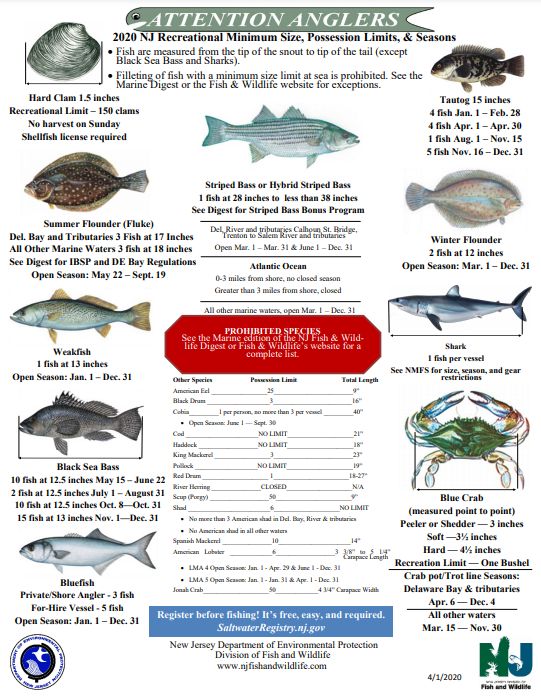
New Jersey now requires registration for saltwater fishing, including lobsters. Registration is free and can be done online at nj.gov/dep/saltwaterregistry.
This listing is for New Jersey waters only - if you cross into New York or Delaware, or Federal waters ( more than 3 miles offshore, ) you are subject to their regulations. Federal regulations supersede state regulations whenever stricter.
Lobster
More: Fishing Regulations ...