Sand Dollar

Echinarachnius parma
Size: to 3"
Think of the Sand Dollar as a flattened Sea Urchin. They live on and slightly buried in sandy bottoms, at any depth.
Soak them in a bleach mixture and then rub off the spines with a rag to get a nice white keepsake. The tiny spines are like cactus needles and can be very irritating. Live Sand Dollars are pink; they turn green in death, and the indelible green pigment will rub off on anything it touches.
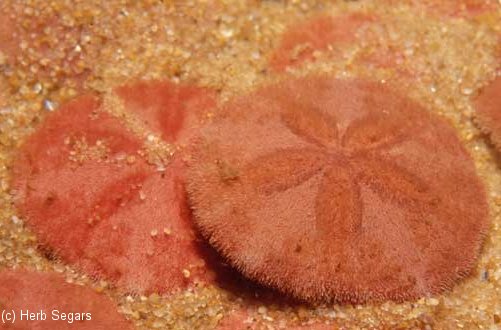
The spines are used like a conveyer belt to move grains of sand along the upper and lower surface of the animal, allowing it to crawl around the bottom and bury itself. They feed on organic material found in the sand, which is passed to the mouth by the tiny tube feet all over the body.

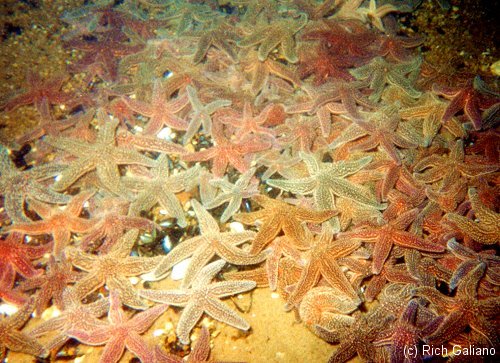
Echinoderms ( literally "spiny skins" ) are among the strangest animals on the planet. They start out as bilaterally symmetric larvae but grow into a 5-way body symmetry as adults. Some species show six, seven, or even higher levels of symmetry. Worm-like Sea Cucumbers have re-evolved a bilateral body plan over the underlying 5-way plan. Because of certain developmental traits, it is felt that despite their strangeness, echinoderms are actually more closely related to chordates than any other group.
More: Echinoderms ...