
Swimming Crabs
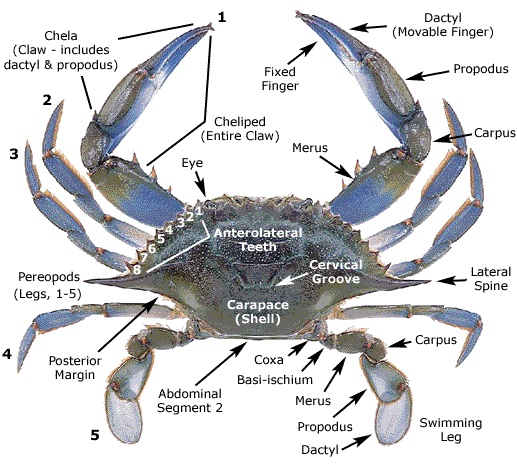
These crabs have the last pair of legs modified into paddles, with which they are remarkably fast and agile sideways swimmers. Apart from this, they retain the walking and burrowing abilities of other crabs. Swimming crabs are bad-tempered creatures that aggressively defend themselves. Large ones can pinch very painfully, so handle with care!
Blue Crab ( Blue-claw )
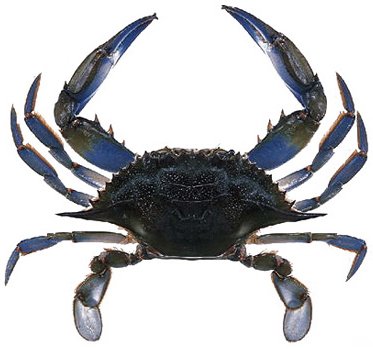
Callinectes sapidus
Profile by Bill Figley
and Ray Townsend
Size:
to 9" across
Range:
Cape Cod to Texas
Habitat:
Bays and estuaries, sometimes found in freshwater, spend their winters in the mud.
Migration:
Blue crabs are relatively stationary and make only local movements. Females prefer saltier waters near inlets for both carrying their young and spending the winter. Males, on the other hand, move to less-saline waters at the heads of bays or in tidal creeks. Young hatch in salty waters and move back into bays and estuaries as they grow older.

Spawning:
Blue crabs spawn between June and August, producing 700,000 to 2,000,000 eggs which the female carries on her abdomen. Females may spawn 2 to 3 times before dying. Eggs hatch in 9 to 14 days.
Feeding:
Plant or animal matter, alive or dead.
Biology:
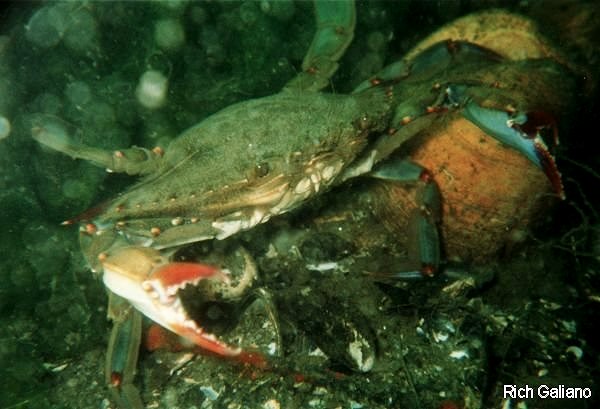
In order to grow, blue crabs must shed their hard chitinous shells. Shedding is a precarious time, for the crab may get hung up in its old shell and die; if it does emerge successfully, its new shell is very soft, rendering the helpless crab vulnerable to predators. For this reason, crabs usually seek the protection of shallow grass beds during the molt. Young crabs molt every few days, while older crabs molt every 20-30 days. After 15-20 molts, female crabs reach maturity. During the last molt, while the female is still soft, mating takes place. The female mates only once, storing the sperm needed for several spawnings.
Recreational & Commercial Importance:
Of all New Jersey's marine fish and Shellfish, more effort is expended in catching the blue crab than any other single species. Surveys conducted by Rutgers University indicate, that three-quarters of the state's saltwater fishermen go crabbing and that crabbing comprises roughly 30 percent of all marine fishing activity. Recreational crabbing is particularly important in the Upper Barnegat, Little Egg Harbor, and Maurice River estuaries, comprising 65 to 86 percent of the total recreational harvest in these areas. The blue crab is especially popular with rental boaters.
The blue crab supports a valuable commercial fishery in Delaware Bay. Over 80 percent of the catch is taken during the warmer months in wire traps. The remainder is harvested during the winter with dredges. Since 1940, New Jersey landings have fluctuated widely, with a peak of 2.9 million pounds in 1975. This peak reflects the recent increased abundance of blue crabs.
Sportfishing Facts and Techniques:
Crabs are abundant all along the Jersey coast, from the Hackensack River to Delaware Bay. The best places to catch crabs are in tidal creeks, rivers, and shallow bays. One of the most popular methods is to use baited lines or traps from the bank or a boat. Most common baits are bunker and chicken necks, but any fresh fish remains will work well. A very inexpensive bait line can be made by tying a 6 oz. sinker and a large (8/0) hook to 15 or 20 feet of cord connected to a small stick for securing and storing the line. A long-handled net is needed to scoop up the crabs which are brought to the surface clinging to the bait. When crabbing from a boat it is a good idea to use both hand lines and traps for sometimes one will produce better than the other. It is also effective to anchor your boat at the bow and stern, to prevent unnecessary movements of the baits. Another technique, especially effective for soft or shedder crabs, is to wade the shallows with a scoop net. This method works only when the water is clear and calm. Remember to release all females bearing an egg mass or sponge.
Acknowledgments & References:
Anthony Hillman (art), Barry Preim (graph), Hamer (1955), Engel (1973), Cargo (1973), Wojcik (1973), Applegate and Sterner (1975), McHugh (1977), Eagleton Poll (1977).
This article first appeared in New Jersey Outdoors

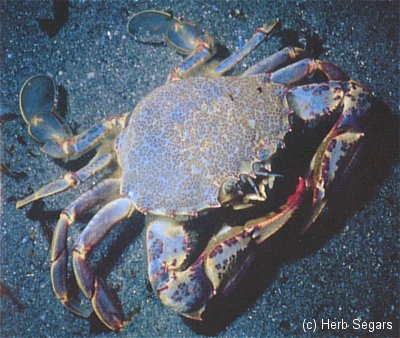

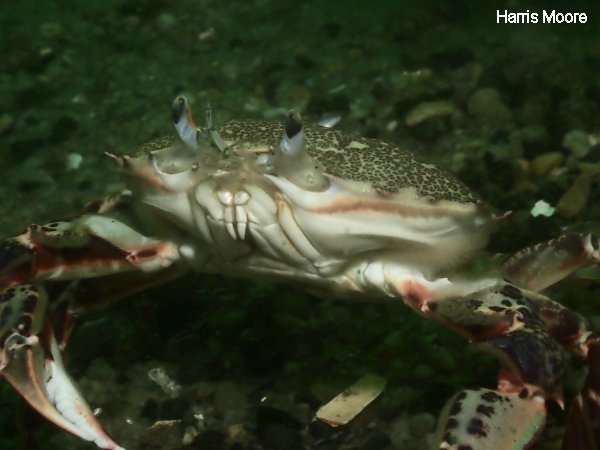
The Lady Crab Ovalipes ocellatus is very similar to Blue Crab, but really too small to eat, growing to a size of 3". It is found in the same environments as the Blue Crab, and has similar habits. In-person, it is one of the most attractive creatures in our waters, colored in purple and cream, with some scarlet and blue mixed in. Also known as a Calico Crab.
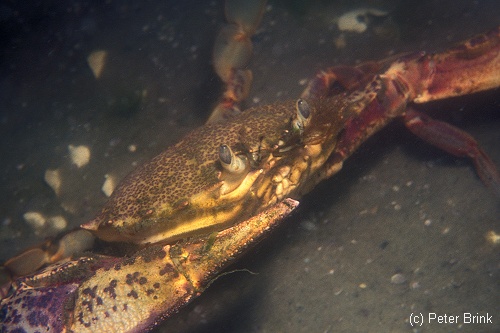

These are all so-called "true crabs".
True crabs are crustaceans with extremely reduced tails, which are carried folded under the body. Males are generally larger than females. Presented here are just the most common of many local species. Sizes quoted below are body width. Hermit Crabs are listed elsewhere. They are not closely related.
More: Crabs ...