Atlantic Mackerel
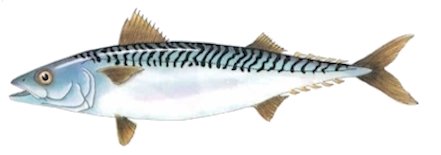
Scomber scombrus
Size
to 22" and 7 lbs.
Description
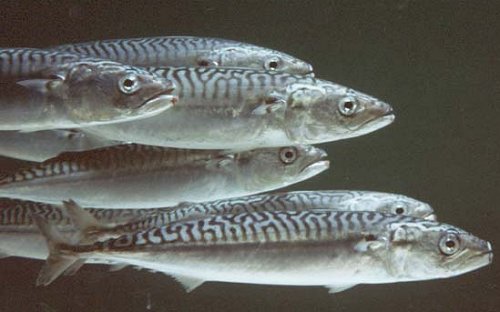
The Atlantic Mackerel is typically an open ocean fish with voracious feeding habits. They travel in schools that often contain thousands of fish. The swift swimming mackerel has a streamlined body and swims at high speeds for extended periods of time searching for food. All individuals within a specific school tend to be the same size. Since cruising speed increases significantly with age and size, scientists believe that conformity of body size within a specific school is necessary to allow all fish to maintain identical swimming speeds. Mackerel may grow as large as 7-1/2 pounds and have a maximum age of about 20 years.
Mackerel reproduce from spring through summer, with more northerly fish spawning later in the season. The mid-Atlantic Bight and the Gulf of St. Lawrence represent the two greatest spawning grounds for this species. Mackerel spawn near the surface and the eggs float in the water column. Many males and females reach sexual maturity at the age of 2 and all do so by 4. The fecundity ( number of eggs produces in a given spawning period ) of females increases as a function of age and size, with an individual female spawning 550,000 to 1,000,000 eggs per season.
Habitat
The mackerel is native to both sides of the Atlantic Ocean. On the US coast, it ranges along the continental shelf from Labrador south to Cape Hatteras, North Carolina. Most mackerel inhabit the inner half of the continental shelf with none straying beyond the shelf's outer edge. Although frequently found near the water's surface, they can also be found as far down as 600 feet.
Feeding Habits
Young mackerel feed on microscopic copepods. As they grow, they feed on progressively larger prey. Adults will eat any fish smaller than themselves, feeding heavily upon small herring, sand lance, and young mackerel. They also consume a variety of invertebrates such as copepods, crab larvae, squid, and shrimp.
As food themselves, mackerel straddles the line between delicacy and cat food, depending on who you ask.