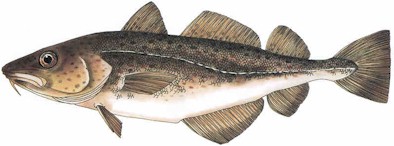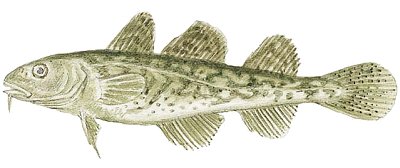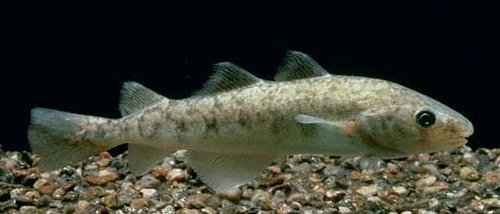
Cods are easily identified: they all have three separate soft-rayed dorsal fins and two separate soft-rayed anal fins. They also have a sensory barbel on the chin, although in some species this is so reduced as to be virtually absent.
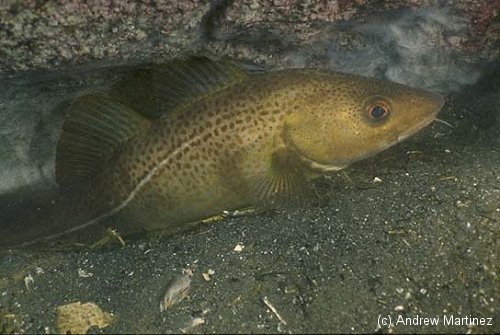
Atlantic Cod Gadus Morhua have been devastated by centuries of overfishing, and large ones are now rare. Some scientists doubt whether the population can ever return to its former level.
Atlantic Cod grow to 4-1/2 ft and 60 lbs, although the record is 6 ft and 211 lbs. A typical fish nowadays is about 10 lbs. Cods are bottom-oriented, and likely to be found in dark places during the day. The meat is excellent eating. I have seen large individuals with an overall steel gray coloring, unlike the illustration.
The Tomcod Microgadus tomcod is a miniature Cod, growing to only 15 inches, and found in shallower waters than its bigger brothers. The rounded tail distinguishes it from other types. It may also ascend rivers.
The 330-foot car float barge Liberty was removed from the Hudson River in sections to clear space for a new ferry terminal at Liberty State Park. Formerly, Liberty was used at the park as a passenger-loading platform for ferries transiting to Ellis Island and the Statue of Liberty since 2005. It sank in a storm in 2020.
N.J. Shore inlet to be surveyed after large sandbar forms
By Nicolas Fernandes NJ Advance Media for NJ.com Aug. 17, 2022
Sand piling up in Manasquan Inlet
Linda Anne, a 38-foot sportfishing boat based in Manasquan, heads outbound from Manasquan Inlet on Thursday, Aug. 11, 2022, in Manasquan. Sand has piled up along the south jetty, which some say has created hazardous navigational conditions as well as a new beach inside the inlet. Andrew Mills | NJ Advance Media for NJ.com
The Army Corps of Engineers will visit the Manasquan Inlet next week to survey a large sandbar that has formed in the waterway, U.S. Rep. Chris Smith, R-4th Dist., said Wednesday.
Sands at the inlet have shifted before, but the low-tide sandbar is larger than anything seen there before, the congressman said.
"We are gravely concerned that it will pose a serious hazard to navigation," Smith said.
Delaware has a string of artificial reef sites in the Delaware bay, but they are of little interest to divers. Most of the sites are quite shallow and perilously close to the shipping lanes, several of them were actually reduced for this reason. The conditions in the bay are hardly good for diving. The reefs consist mostly of concrete rubble from construction in Philadelphia and other cities on the river. Also shown is New Jersey's sole artificial reef in the bay.
The Office of Coast Survey's Automated Wreck and Obstruction Information System (AWOIS) contained information on over 10,000 submerged wrecks and obstructions in the coastal waters of the United States. Information included latitude and longitude of each feature along with brief historic and descriptive details. The AWOIS system has been discontinued, the replacement is here.
The Pauline Marie sinks slowly on the Atlantic City Reef.
By Evelyn DeWitt Myatt & Bill Figley, 1986
It's hard to imagine anything that could have looked more forlorn than the rusty old freighter whose proud seagoing days were a thing of the past. Floating idly at her berth awaiting her fate, she was a victim of nature's ravages that had left her beautiful only in the eyes of her old captain and crew. The Pauline Marie, however, was not destined to be the victim of a cutting torch that would turn her into a tangle of scrap steel. Instead, she was acquired by the New Jersey Artificial Reef Program and went down with dignity as an artificial reef in March 1985. She now provides continuing services from her watery grave in the Atlantic, some twelve miles off Atlantic City, and her appeal to marine life is undeniable. Her interior compartments now shelter fish and crustaceans; her decks now provide substrate for mussels, soft corals, and plant life; and her newfound productivity has put delicious seafood on many tables.
Submarine Defender as rebuilt with sharply raked bow, and her topsides changed, ready for launch at Lake's Bridgeport base. Above her twin propellers is the shutter of a stern torpedo tube. Lake's characteristic pair of amidships planes have been folded up (they are forward and abaft the big conning tower).