Long-liners
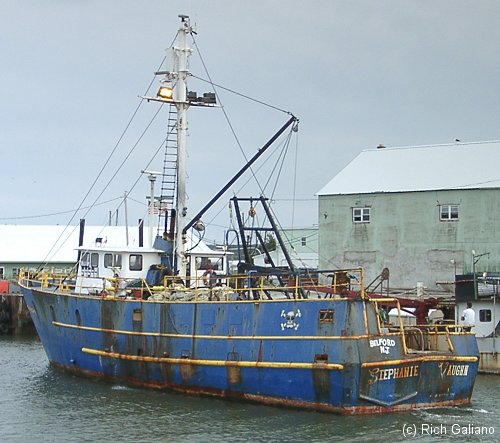
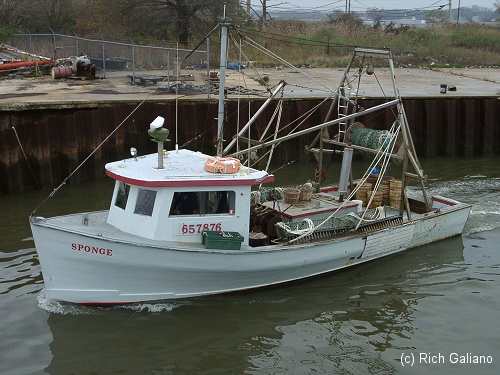
A long-liner returns to its homeport of Belford. Long-lining is a very labor-intensive operation, and the asymmetrical hull design, high on one side and low on the other, affords the crew some protection from the weather. Gear is also stored along the high wall, and recovered, along with the catch, along the low wall.
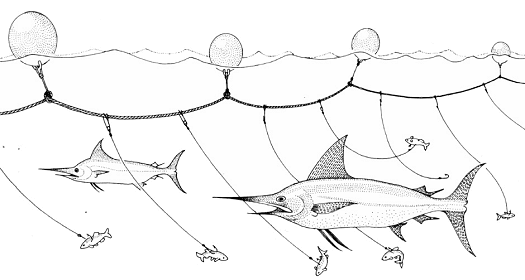
Long-lining is an ancient form of fishing in which multiple baited hooks are attached with leaders to a long backbone line, which is suspended at a targeted depth from buoys, and either anchored or allowed to drift. This targets surface-feeding fishes such as Swordfish. Long-lines may also be set deep to target bottom-feeding fishes such as cod. Commercial long-line fishing in the North Atlantic began in the early 1960s. The lines may be 15 miles long or more.
Long-lining is a fairly indiscriminate method that catches whatever takes the bait, and the bycatch is significant. In the last few decades, the long-line fishing industry has grown tremendously, with large boats putting out miles of line in search of sharks and swordfish, both of which are now greatly reduced in numbers. The Andrea Gail of The Perfect Storm was a Gloucester "Sword Boat, " but many such vessels are also based right here in New Jersey and Long Island. New Jersey boats are more likely to be after sharks than swordfish.
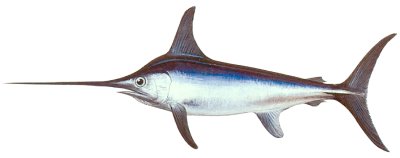
Sword fishermen routinely discarded thousands of sharks as bycatch, most of which were dead already, and the rest killed before they could be safely handled. When swordfish became scarce, the long-liners began targeting the sharks themselves instead. Now sharks are scarce.
A monstrous variation on long-lining is drift netting, practiced mainly in the Pacific by far-eastern fishing fleets. Huge floating nets, sometimes hundreds of miles long, are set out to ensnare anything that comes along. There is no such thing as bycatch to a drift-netter - tuna, sharks, squid, seals, dolphins, turtles, whales - everything goes into the freezer. When such a net is lost, it goes on killing until it eventually sinks under the weight of all the rotting sea life it has captured. Drift netting is largely banned, but some countries pay little heed to international law, and far out at sea where no one is watching ...
There are three basic types of commercial fishing vessels found in the Mid-Atlantic region: trawlers, seiners/gill-netters, and long-liners. A trawler or "dragger" operates by towing its fishing gear across the bottom. Weighted nets take bottom fishes, while cage-like steel dredges take clams and scallops. A seiner uses a floating net to encircle schools of surface-swimming fishes such as herring and tuna. A long-liner sets out miles of buoyed line with baited hooks to catch sharks, tuna, and swordfish. One could also add lobster boats and charter fishing or "head" boats to this list. And of course, dive boats.
More: Fishing Vessels ...