
Spearfishing Techniques
General
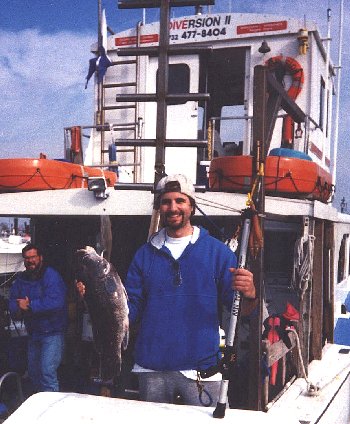
Most underwater hunting in New Jersey waters is done around some sort of structure. Surprise is often the key element to a successful hunt. "Get the drop" on a fish by rounding a corner or popping up over a wall while holding your breath. Don't use a light - this just spooks the fish. Instead, let your eyes adjust to the dark. This way you can see as well as they can, although they can still hear and feel you coming a mile away. Use your light only to peek into black holes, and keep one eye closed when you do, to avoid losing all dark adaptation.
Try to be the first person in the water. The fish will be in a relaxed and unworried state, and you will likely get the first one "for free". This is especially true if you are after trophy-sized Blackfish. Whether or not you score on your first shot, after that all the fish in the area will be spooked. This is because they produce "fear scents" - chemical excretions that warn other fish that there is danger. If you make a kill, you will put blood in the water, which is even worse. So make that first shot count. On the other hand, sometimes the scent of blood will bring in more fish, such as greedy Sea Bass, although more often just Cunners.
If you can't be the first one in the water, try to be the last. Sometimes, you can use the other divers as "beaters" to drive the fish to some distant part of the wreck. This technique works well on large broken-up wrecks such as the Mohawk, but you must take extra care not to get lost. On smaller intact wrecks, previous divers will have driven the fish either inside the wreck or off to something else nearby, such as an APC in the reef. Start looking in holes.
Another hunting technique is to use bait. Smash a pile of mussels, and then back away to the limit of visibility. Small fish will come in immediately for the free meal, and the commotion may draw in the big ones. Do this in several locations, and move between them.
Different fish react differently to being speared. Sea Bass will often just stiffen up, as will Bluefish. Monkfish are fairly placid if hit correctly, but flounders usually put up some fight. Blackfish almost always go into a violent frenzy of thrashing and spinning. Ling also tend to thrash. If you don't act quickly, these fishes will tear themselves apart, get off the spear, and dart away to die. I always feel bad when this happens, although the dead fish will serve as food for others to grow on, and so is not a total loss. You must expect a certain percentage of your hits to get away like this, but there are ways ( see below ) to minimize the losses.
Get your catch on ice as soon you get back to the boat and then clean it as soon as possible after getting back to port.
Pole Spear
With a polespear, you must be pretty close to your target to hit it accurately and with enough power to make a kill. Four to five feet is the outside limit. You may score an occasional long-range hit, but these often simply glance off harmlessly, especially if you are after Blackfish. Aiming a pole spear is simply a matter of practice. At first, you may not be able to hit anything, as you are basically shooting from the hip, and parallax in the water is different from parallax in the air. Fortunately, since a pole spear never leaves your hand, it is often possible to reload and try again on the same fish!
Once you've scored a hit, immediately pin the fish up against something solid, driving the points of the spear through it so that there is no way it can escape, no matter how it thrashes. Slip your thumb out of the bungee loop, and slide your hand up the shaft of the spear, keeping the fish pinned until you can get your hands on it. Don't try to pull the fish to you. Get your catch bag out, and bring it down to where you are keeping the fish pinned. Get a good grip on the fish, and shove it head-first, spear and all, into your bag. Close the bag around the spear, and pull it out. The barbs of a paralyzer are small enough to pull right out.
It is tiring to carry a fully-cocked pole spear for any period of time, and also difficult to aim one quickly with just one hand. The length of the spear behind you makes it swing very slowly onto target. Sometimes you can guide the back end of the spear with your foot, but this is effective only for a limited firing arc.
A better way is to carry your spear cross-wise in front of you with both hands: your right hand with your thumb in the bungee loop, perhaps slightly tensioned, and your left hand near the spear point ( reverse for lefties. ) You can swim around looking for fish this way with virtually no effort. When a target is found, push the spear to the cocked position with your left hand, while simultaneously swinging the spear onto the target with both hands. With a little practice, you can aim and fire very quickly. Another advantage of this method is safe, since the spear is carried in an uncocked state most of the time, with the dangerous end pointed in a relatively harmless direction. Carry your catch bag in your left hand as you hunt, so it is ready for immediate use.
Pole spears are great for shooting fish in enclosed spaces. Many fish like to hide in holes and crevices, such as the gap beneath the hull of a shipwreck or hull plate. You can often get these fish simply by jabbing at them without the elastic band. The difficult part is pulling them out of the hole without having them get off. This is why a barbed spear point is essential. Also, try for a solid head shot, and be sure to plant the points very firmly in the fish. If there is room enough, try swinging the fish out sideways rather than pulling it straight out.
Speargun
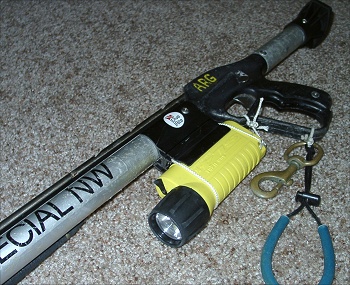
Right: UK SL4 light mounted to JBL speargun for night hunting. Mostly, this just scares the fish away.
If you can be the first and/or only person in the water, load your gun on the way down the anchor line, so you will be completely ready when you reach the wreck. Do not load a speargun while descending the anchor line if there is a possibility of other divers ascending it at the same time. Pulling the bands onto a speargun is probably the most dangerous time of all, when a slip of the hand might accidentally fire the gun. You can often get a big Blackfish within seconds of hitting the bottom if you are prepared.
I have found that there are two reliable ways to aim a speargun. Either hold it up to eye level and sight carefully down the shaft for a long shot, or put it up point blank to your target and fire. Most fishes, especially large ones, are not cooperative with the second method.
After scoring a hit, drop the gun immediately, swim to the fish and pin it down. If you try to pull a struggling fish to you with the shock line, 99% of the time it will work itself free and you will lose it. Get a solid grip on the fish, and shove it into your bag. Removing a barbed spear point is more complicated than a paralyzer: you have to push it through the fish and then fold the barbs down and pull it back out. If the fish is already in the bag, there is much less chance of losing it while you fuss with the mechanicals.
Many spearguns are nose-heavy, and can be tiring to carry in firing position. You can prop it up on your free hand, but take care not to get entangled in the shock cord when your fire. The light in the picture above makes a handy grip as well. Carry your catch bag in your free hand, or clip it to the gun, so it will be readily accessible. Since spearguns have such a low rate of fire, you really must look for trophy-sized fish to shoot if you expect the endeavor to be worthwhile. In fact, with a powerful gun, some smaller fishes like ling may simply burst when you hit them.

Most folks catch fish with hook and line. A successful fisherman combines skill, knowledge, and experience with a good deal of luck to essentially trick a fish into catching itself. If the fish won't bite, you go home empty-handed. However, scuba divers have a much more dynamic method available to them - spearfishing. Spearfishing is more akin to hunting than to hook and line fishing: rather than relying on a convincingly presented bait or lure, the spearfisherman enters the environment of his quarry and pursues it on its own terms.
More: Spearfishing ...